ON THIS PAGE 11 sections
What is agentic AI in SEO?
Agentic AI in SEO is an autonomous system that pursues a goal end-to-end: it observes data (GSC, crawl logs), reasons about the next step, executes via tool APIs (CMS, crawler, Slack), and reflects on the outcome — without a human prompting each step.
Agentic AI is not a chatbot waiting for a prompt. It is an autonomous system capable of breaking down complex goals into distinct tasks, executing them using external tools, and self-correcting based on real-time feedback. While Generative AI writes, Agentic AI acts. This is the fundamental difference between a passive tool and a scalable digital workforce.
If you are still hiring junior marketers to copy-paste prompts into ChatGPT, you are already behind. The market has shifted from “assisted SEO” to autonomous SEO workflows, and businesses that fail to architect these systems will find themselves outpaced by competitors running on operational autopilot.
What is Agentic AI?
To understand agentic AI, you must first unlearn the behavior taught by standard Large Language Models (LLMs). When you interact with a raw model, the interaction is stateless. You provide an input, it provides an output, and the transaction ends. The model has no memory of the exchange once the context window closes, and more importantly, it has no native ability to do anything outside of generating text or code.
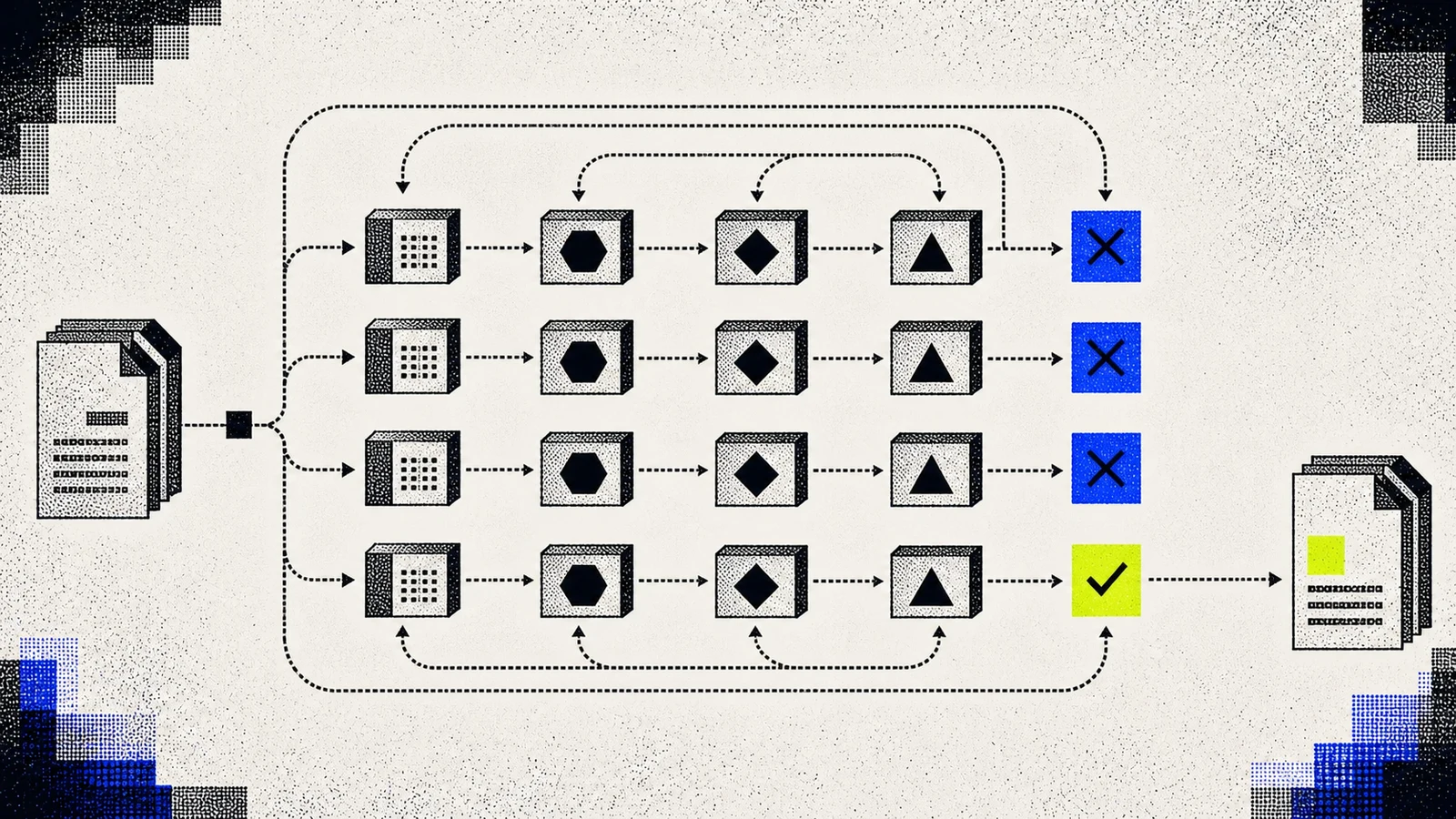
Agentic AI introduces a loop of agency. For a parallel use case, see how intent classification with AI applies the same observe-think-act loop to query routing. It operates on a recursive framework: $$Observation \rightarrow Thought \rightarrow Action \rightarrow Reflection$$
An agent doesn’t just predict the next token; it pursues a goal. It has access to a “toolkit”—which might include a SERP API, a Python execution environment, or your CMS credentials. When given a directive like “Analyze the drop in organic traffic for /pricing,” an agent does not just hallucinate a generic reason. It:
- Observes: Accesses Google Search Console via API.
- Thinks: Identifies a pattern of declining impressions on specific queries.
- Acts: Queries a crawler to check if the page’s technical status changed.
- Reflects: Realizes the page is canonicalized to a staging URL (an error) and flags it.
This is operational intelligence. It is the shift from a tool that helps you work, to a system that does the work for you. The practical version is a small portfolio of AI agents for SEO operations with narrow permissions, explicit evals, and workflows that ship measurable outputs.
Generative AI vs. Agentic AI: The Crucial Difference
Most B2B SaaS companies are currently stuck in the “Generative” phase. They are using AI to generate blog posts, write meta descriptions, or brainstorm ad copy. This is low-leverage work. It saves minutes, not money.
To scale revenue, you need agentic workflow automation. You need systems that run while you sleep, not tools that wait for you to wake up and type.
Here is the breakdown of why GenAI is a toy compared to the architectural power of Agentic systems:
| Feature | Generative AI (The Tool) | Agentic AI (The System) |
|---|---|---|
| Trigger | Requires manual prompting per task | Given a high-level goal (e.g., “Fix 404s”) |
| Autonomy | Zero (Passive) | High (Goal-Seeking) |
| Tool Use | Limited (mostly text/image generation) | Unlimited (Can access APIs, run Python, browse web) |
| Feedback Loop | None (unless user re-prompts) | Self-correction loops (Reflects on errors) |
| Outcome | Creates Assets (Text, Code) | Creates Outcomes (Solved Tickets, Rankings) |
Generative AI requires you to be the pilot. Agentic AI allows you to be the Air Traffic Controller. The difference in operational overhead is massive.
The Architecture of an SEO Agent
You cannot buy an “SEO Agent” off the shelf. You must architect it. As an SEO & AI Automation Architect, I view these agents as a stack of three distinct components. If you are building internal growth engines, this is the blueprint you need to follow.
1. The Brain (The LLM)
This is the reasoning engine. In 2026, we typically use models with high reasoning capabilities—such as GPT-5 or Claude 5—as the orchestrator. The “Brain” is responsible for breaking a high-level goal (“Improve Core Web Vitals”) into a chain of logical steps.
2. The Tools (The Hands)
An agent is useless without hands. We give the agent access to specific utilities via API keys:
- Search: Google Custom Search API or Serper.dev for live SERP data.
- Data: Google Search Console and GA4 APIs.
- Crawling: Screaming Frog (headless mode) or custom Python scrapers.
- Execution: CMS access (WordPress REST API) or GitHub repositories.
3. The Memory (The Context)
Standard LLMs have amnesia. To make an agent effective over time, we connect it to a Vector Database (like Pinecone or Weaviate). This allows the agent to store learnings, retrieve past audits, and maintain “state.” It remembers that it fixed a canonical error on the pricing page last week, so it won’t flag it as a new issue today.
This architecture is orchestrated by modular frameworks like LangGraph or CrewAI. These frameworks handle the logic flow, ensuring the agent doesn’t just stop if it hits a roadblock, but attempts to reroute—just like a human engineer would.
Inside the three-layer agent stack
Observe, Orient, Decide, Act
1. Observe
Monitor SERP APIs, GSC Data, and Competitor HTML continuously.
2. Orient
Analyze semantic gaps via Embeddings & LLM Context windows.
4. Act
Push JSON-LD payload to Headless CMS / Vector DB via API.
3. Decide
Plan architecture changes (Inject internal link, rewrite H2, etc.).
3 Use Cases for AI Agents in SEO
If you are using AI to write blog intros, stop. That is a waste of computing power. We deploy AI agents for SEO to handle the heavy lifting—the technical infrastructure and data analysis that humans are too slow to execute at scale.
Here are three autonomous SEO workflows we implement in modern revenue architectures.
1. Autonomous Technical Auditing
Traditional technical audits are static PDFs that gather dust. An Agentic Audit is a live, self-healing process.
The Workflow: We configure an agent to run a headless crawl of the site architecture weekly. The agent connects to the crawler via CLI (Command Line Interface). It parses the raw JSON output, filtering out the noise (warnings) and isolating the critical errors that impact revenue (4xx errors, 5xx errors, orphan pages).
The “Agentic” Part: The agent does not send you a spreadsheet.
- It identifies a 500 error on a transactional page.
- It accesses the server logs to identify the timestamp of the crash.
- It drafts a Jira ticket for the engineering team, including the exact error log and the specific line of code causing the conflict.
- It assigns the ticket to the relevant developer based on the git blame history.
The marketer never touches the data. The problem moves from “detection” to “resolution queue” automatically.
2. Self-Correction of Broken Links
Link rot is a silent revenue killer. Managing it manually is tedious. Managing it via Agentic AI is invisible.
The Workflow: An agent monitors the server access logs for 404 responses from external referrers. When a high-authority domain links to a page that no longer exists, the agent triggers a recovery protocol.
- Retrieval: The agent accesses the Wayback Machine API (within ToS limits) to analyze the content that historically existed on that URL.
- Analysis: It embeds that historical content into a vector and queries the current site map for the most semantically similar live page.
- Execution: Using a strict similarity threshold, the agent prepares a 301 redirect map for review or direct implementation via the CMS API.
- Reporting: It logs the action in a Slack channel: “Recovered backlink from Forbes. Redirected /old-post to /new-guide.”
This is technological sovereignty. The system protects your link equity without human intervention.
3. Dynamic Internal Linking Updates
Internal linking is often neglected because it requires remembering every piece of content you have ever published. Agents have perfect memory.
The Workflow: When a new high-intent asset is published, the agent scans the existing content library. It doesn’t just look for keyword matches; it looks for semantic gaps where the new article provides value.
It calculates the “link equity” distribution to ensure the new page gets enough internal authority to rank. It then inserts the internal links automatically into older posts.
This connects directly to automated intelligence systems that monitor your niche for gaps, ensuring your internal architecture is always mirroring the current state of market demand.
Compare the three agentic workflows
| Agent Role | Primary Responsibility | Tool Access (APIs) | Output Directed To |
|---|---|---|---|
| The Orchestrator / Manager | Delegates tasks, evaluates outputs, prevents loops. | LangChain/LangGraph Memory | Specialized Worker Agents |
| The Researcher | Scrapes real-time SERPs, extracts competitor entities. | ScrapingBee, DataForSEO, Exa | The Writer / The Auditor |
| The Writer | Generates structured HTML/JSON payloads matching intent. | Claude 3.5 Sonnet, GPT-4o | The Auditor (For Quality Assurance) |
| The Auditor / Editor | Checks for hallucinations, tone of voice, and exact semantic matches. | Vector/Embeddings DB (Pinecone) | The Execution API (Or returns to Writer) |
| The Execution Agent | Commits final changes directly to the database. | PostgreSQL, Contentful API | Production Edge Network |
The Risks: Hallucinations and Loop Traps
I believe in Radical Transparency. Agents are powerful, but they are not infallible. Without proper architecture, autonomous SEO workflows can become destructive.
Infinite Loops
An agent can get stuck in a logic trap.
- Observation: “I need to fix the title tag.”
- Action: Updates title tag.
- Reflection: “The title tag is still not optimized.” (Due to caching lag).
- Action: Updates title tag again.
This burns API credits and server resources. We engineer “time-outs” and “retry limits” (max iterations = 3) to prevent resource drain.
The “Destructive” Commit
An agent effectively has “root access” to your marketing stack. If it hallucinates that your homepage is a duplicate of your about page, it could theoretically canonicalize your homepage to /about.
The Solution: Human-in-the-Loop (HITL)
We do not let agents touch a production database or the robots.txt file without a validation gate. This is operational suicide.
The agent executes 90% of the work—the research, the coding, the drafting. It then pauses and requests a “commit approval” from a senior SEO. You click “Approve,” and the agent executes. You maintain control; the agent provides the velocity.
- Repetitive technical work. Audits, redirect maps, internal link injection, broken-link recovery. High volume, clear pass/fail.
- Data-heavy analysis. Cross-referencing GSC against CRM, log files against sitemap. Agents don't get tired.
- Brief-driven content. When the brief is rigorous and the rubric is explicit, drafting and editing scale.
- No human-in-the-loop. Agents will canonicalize your homepage to /about if the prompt is ambiguous. Always gate production writes.
- No retry limits. Infinite loops burn API credits in hours. Cap iterations at 3-5 per goal.
- No eval rubric. Without a structured 'is this output good' check, drift compounds. The eval is the moat, not the model.
Future Outlook: Generative Engine Optimization (GEO)
The rise of Agentic AI isn’t just changing how we do SEO; it is changing the search engines themselves. We are moving toward Generative Engine Optimization (GEO).
Search engines like Google AI Overviews and Perplexity are becoming “Answer Agents.” They don’t want to send users to your site; they want to read your site, synthesize the answer, and present it directly.
In this environment, you are no longer optimizing for a human click. You are optimizing for an agent’s citation.
Your technical SEO architecture must be pristine. Agents (both yours and Google’s) struggle with messy code, slow DOM loading, and unstructured data. To win in GEO, your data must be structured so clearly that a machine can parse your value proposition without friction.
- Schema Markup is no longer optional; it is your vocabulary.
- Entity congruency is your reputation.
- API accessibility is your distribution channel.
The Directive
The era of manual SEO execution is over. The complexity of modern search, combined with the volatility of agent-driven algorithms, makes manual optimization mathematically impossible to scale.
You have two choices:
- Continue paying humans to do robotic tasks (and watch your margins erode).
- Audit your system and begin architecting a workforce of agents that compound your growth 24/7.
Agentic AI is not a luxury. It is the new baseline for operational intelligence. Stop asking what AI can write for you, and start defining what AI should do for you.
If you are ready to stop guessing and start engineering revenue, we need to talk about your architecture.
Estimate your agentic SEO automation payoff
Continue down this pillar
Agentic SEO is wide. Pick the sub-topic that maps to your next bottleneck:
- Start with the build economics in programmatic SEO architecture — the foundation most teams skip.
- Apply the loop to discovery work via competitive intelligence systems and LLM-driven competitor gap analysis.
- Operationalize the writer-replacement side with intent classification pipelines and LLM content auditing at scale.
- Design the production contract with AI writer brief templates and enforce it through AI content eval loops.
- Model the operating threshold before scaling with agentic SEO cost economics.
- Run the upkeep layer through automated internal-linking and understand the trade-offs in programmatic vs AI content.
- If you want this built for your stack, see agentic SEO services.
Q01 What is the difference between generative AI and agentic AI? +
Q02 Can I buy an SEO agent off the shelf in 2026? +
Q03 What frameworks do you use to build SEO agents? +
Q04 How do I keep an SEO agent from breaking production? +
Q05 What is GEO and how does it change SEO? +
- [01] DOC
- [02] GUIDE
- [03] DOC
The same pipelines I run for paying clients — written up first for subscribers.