ON THIS PAGE 12 sections
What is topical authority in SEO?
Topical authority is an SEO operating model for how completely, usefully, and coherently a site covers a subject. You build it with distinct owner pages for real search intents, strong internal routes, original evidence, and topic-relevant external validation. Google has no public topical authority score, so measure the observable layers instead of claiming a hidden metric.
Topical authority is an SEO model for a website’s depth, coverage, and coherence on a specific subject. It is built not by writing one great article, but by making a useful network of distinct answers, evidence, and internal routes around the topic.
If your SEO plan is a queue of disconnected keywords, the missing unit is not another article. It is a subject system: clear ownership for each intent, useful relationships between pages, original evidence, and a maintenance loop.
Google has not published a standalone “topical authority” score or ranking factor. I use the term as an operating model for building a site that repeatedly provides useful answers across one bounded subject. That distinction matters because it keeps the strategy observable instead of turning it into folklore.
If you sell AI automation software but publish unrelated posts about productivity, remote work, and generic marketing, you spread editorial effort and internal links across several subjects. A focused competitor has a smaller graph to complete and a clearer audience to serve.
When a potential client searches for a high-intent technical term in your niche, Domain Rating alone does not decide the result. The winning page still needs to match the intent, answer the question, expose credible evidence, and sit inside a site structure that search engines can understand.
This isn’t just content marketing. It is semantic engineering — and it only becomes visible to search systems when the technical delivery layer exposes stable URLs, crawlable links, and coherent documents.
Without durable organic visibility, paid acquisition remains the default way to reach existing demand. This guide explains how to build an owned alternative.
What Is Topical Authority? (And Why It’s Not Just “Quality Content”)
In simple terms, topical authority is a working hypothesis: a site should become a stronger candidate when it repeatedly provides satisfying answers across one connected subject area.
Historically, SEOs obsessed over keywords. A keyword is just a string of text. “CRM software” is a string.
Modern search systems do more than match exact strings. Google documents systems such as BERT and neural matching that help it understand how words and concepts relate, while its Knowledge Graph represents known entities and relationships.
An entity is a concept—a person, place, thing, or idea that is distinct and independent of the language used to describe it. Google knows that “CRM,” “Customer Relationship Management,” and “Salesforce” are semantically related entities.
Think of Google as a librarian. If a student walks in and asks a complex question about “Neuroscience,” the librarian has two choices:
- Hand them a single, well-written pamphlet by a general journalist.
- Direct them to a dedicated shelf containing an encyclopedia, three textbooks, and ten case studies, all written by neuroscientists.
For a complex question, the dedicated shelf is usually the more useful destination. Your website is either the pamphlet or the shelf. Topical authority SEO is the process of building the shelf. If the blank canvas is the blocker, use the 90-minute topical map recipe to draw the first version before opening a keyword tool.
The shift from keywords to connected concepts
A topical map does not need to reverse-engineer or mirror Google’s private systems. Its practical job is simpler: represent the real concepts, tasks, alternatives, risks, and decisions a buyer needs to navigate.
You are not just targeting keywords; you are building a coherent body of answers around an entity. When the system works, two things can happen:
- New pages inherit context. Clear internal links help crawlers and readers understand where a page belongs.
- Pages match more related queries. A complete answer can earn visibility across long-tail variations without creating one page per keyword.
Note: Do not label the cluster “E-E-A-T optimized” and call it finished. Expose who did the work, what they observed, which source supports each claim, and where the evidence stops. My E-E-A-T guide covers that proof layer.
How to audit topic coverage without inventing a ranking formula
Google does not publish a checklist of terms that earns topical authority. Entity and relationship analysis is still useful as an editorial audit, provided you do not present it as Google’s private scoring formula.
Entity and relationship coverage
If you write a 2,000-word guide on “SaaS Marketing,” but never address “churn,” “CAC,” “LTV,” or “product-market fit,” the page is likely shallow for many real SaaS marketing intents.
Their absence may expose a missing subproblem, but stuffing the words into a paragraph does not create depth. Check whether each concept has a reason to be present, a useful explanation, and a route to the next decision.
Semantic distance as a planning tool
Embeddings and vector models can help an SEO team cluster related queries or detect outliers. Use them to create a review queue, not to decide truth. A page about “SEO” and one about “backlinks” may belong together; a page about office furniture probably needs a different hub. Human intent review still decides whether two pages answer the same job.
- B2B niches with a sales motion. Sales calls reveal the entities to cover. Authority becomes a moat against generalists.
- Companies building owned demand. A maintained subject library can keep matching demand after the initial production work. It still needs evidence, links, and updates.
- Teams willing to consolidate content. Merging overlapping pages and retiring unsupported noise can make ownership clearer. Focus matters more than raw page count.
- Pre-PMF startups. You don't know what you sell yet. Wait until sales calls show a repeatable pain point.
- Generalist publishers. If your editorial calendar covers 10 unrelated topics, no single one will earn authority.
- Teams without a maintenance owner. A cluster decays when nobody owns links, evidence, cannibalization, and decision-critical updates.
How topical authority and backlinks work together
A lower-DR site can outrank a stronger domain for a specific query, but coverage does not cancel the value of links. The page still competes on intent fit, usefulness, evidence, technical eligibility, and external signals.
Treat links and topical coverage as different layers. Links can help discovery and convey importance; a coherent cluster helps each page do a distinct job and gives readers useful next steps. Neither layer guarantees rankings on its own.
The Specialist vs. The Generalist
Consider a broad publisher that writes about hundreds of industries.
Now consider your B2B SaaS company that sells inventory management software for pharmacies.
It might publish one article about “inventory software” without covering pharmacy expiration tracking, DSCSA compliance, or medication dispensing workflows.
If you build a focused cluster covering the real workflows, constraints, and questions in pharmacy inventory, you give Google a more precise result for those high-intent queries. That creates a credible route past broader publishers, even without matching their backlink profile.
Owned coverage versus rented distribution
Paid distribution stops when the budget stops. A useful page can keep matching demand, but it is not a one-time capital asset: facts age, competitors improve, links break, and search behavior changes.
Model the system honestly. Track production, maintenance, technical work, and distribution costs against qualified organic sessions, assisted pipeline, and closed revenue. My SEO ROI framework shows how to keep those assumptions visible.
Where Domain Authority and Domain Rating fit
Moz Domain Authority, Ahrefs Domain Rating, and Semrush Authority Score are backlink or domain-level diagnostics. Topical authority describes how well a site covers and connects one subject. They answer different questions, and none is a public Google score.
A focused cluster still needs external validation. A strong domain still needs the right page for the query. Use the complete Domain Authority vs Domain Rating comparison when you need to choose or interpret an authority metric; keep this pillar focused on building subject coverage.

The Pillar-Cluster Architecture (The Infrastructure)
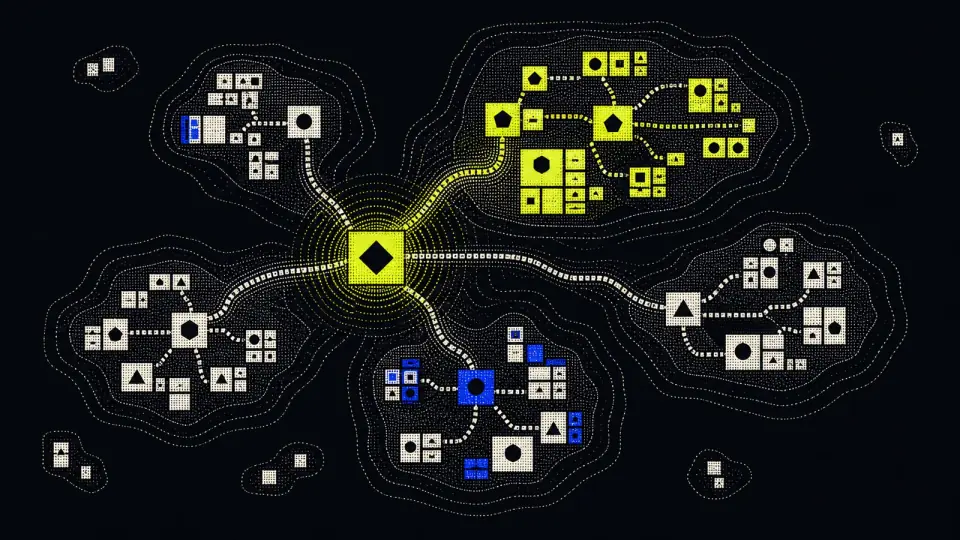
You cannot build authority by blogging randomly. You need an architecture. This is best visualized as a Hub-and-Spoke model, often called Pillar-Cluster content.
For a deep dive on the specifics of the hub page itself, read my guide on what a pillar page is and how to create one.
Hub-and-Spoke Content Model Explained
The architecture consists of three distinct components. If you miss one, the system fails.
1. The Pillar Page (The Hub)
This is the high-level parent page. It targets the broad, high-volume keyword (e.g., “AI Automation”). A Pillar Page is broad, not deep. It acts as the Table of Contents for your website’s “book” on the topic.
2. The Cluster Content (The Spokes)
These are the supporting pages. They target specific, lower-volume, higher-intent keywords (e.g., “AI agents for sales prospecting,” “Automating SEO reporting”). Cluster pages are deep, not broad. They solve one specific problem comprehensively.
3. The Glue (Internal Linking)
This is where many clusters become disconnected. A practical internal linking pattern is:
- The pillar links to each supporting answer that belongs in its scope.
- Supporting pages link back when the pillar is a useful orientation point.
- Adjacent pages link to each other when they answer the reader’s natural next question.
This creates understandable routes through the subject and helps crawlers discover how the pages relate. Links can also convey importance, but do not assume one backlink mechanically “trickles” a fixed amount of authority through every page in the cluster.
See the hub-and-spoke model
Topical Authority
An operating model for coverage, evidence, and a legible content graph
Depth
Comprehensive coverage of each subtopic within your niche
Breadth
Full topic cluster coverage across all related entities
E-E-A-T
Experience, expertise, authoritativeness, and trustworthiness signals
Internal Links
Hub-spoke architecture distributing link equity across the cluster
Freshness
Regular content updates and date signals that prevent decay
Backlinks
Topic-relevant external links reinforcing domain expertise
How to Build a Topical Map (The Execution)
We are done with theory. Here is exactly how to build topical authority using a systematic mapping process.
Need the technical workflow underneath? See pillar pages and internal linking for the implementation layer.
Step 1: Identify the Core Entity (Not the Keyword)
Do not start with a keyword. Start with your business offering. What do you actually sell? That is your Core Entity.
- Bad: “Software.”
- Better: “HR Software.”
- Perfect: “Employee Onboarding Automation for Enterprise.”
The more specific your core entity, the easier it is to build authority quickly.
Step 2: Scrape the “People Also Ask” (PAA) Data
Traditional keyword-first tooling shows you what people type. PAA data shows you what people mean. Google’s “People Also Ask” boxes represent the relationships between questions in Google’s database.
Go 3-4 layers deep to form the skeleton of your topical map:
- Layer 1: What is onboarding automation?
- Layer 2: How much does onboarding software cost?
- Layer 3: Can I integrate onboarding software with Slack?
Step 3: Group by User Intent (Entity Clustering)
You will end up with hundreds of keywords. Many mean the same thing (e.g., “Best onboarding tools” vs. “Top software for new hires”).
Group your keywords by Intent. If the search results for two keywords are identical, they belong on the same page. If you write two pages for the same intent, you are cannibalizing your own authority.
Step 4: The Gap Analysis (Information Gain)
Once you have your map, compare it to your competitors. Look for the “Zero” spaces.
- Where are they outdated?
- What questions are they failing to answer?
This is the practical version of information gain: add something useful that the existing results do not already provide, instead of paraphrasing the current SERP.
Step 5: Execute the Content
You now have a list of required pages. Do not turn velocity into a vanity metric. Ship a coherent first cluster quickly enough that its pages can support each other, but keep quality gates in place. Programmatic SEO architecture helps only when each output has unique inputs and a distinct job.
Step 6: Prioritize by Pipeline Value, Not Alphabetical Order
Most maps die in execution because teams start writing whatever is “easiest” or alphabetically first. Score every page on the map against two variables:
- Revenue potential (intent): “What is CRM” is low intent. “Best CRM for enterprise sales” is high intent.
- Ranking difficulty: Can you win this in 90 days?
Build the bottom of the funnel first. If you have a limited budget, write the 10 comparison pages (“Us vs. Competitor”) before the 50 definition pages. Lower traffic, higher conversion, revenue that funds the rest of the campaign.
How to improve topical authority on an existing site
Do not start by publishing another batch of articles. Improve the existing system in this order: define the subject, resolve page ownership, repair its internal routes, fill the most valuable gaps, and add evidence worth citing.
1. Define the subject boundary
Write one sentence that names the audience, problem, product context, and exclusions. “SEO” is too broad. “Technical SEO for Shopify stores with large filtered catalogs” is narrow enough to map and maintain.
2. Assign one owner URL per intent
Export the current URLs and queries, then group them by the result a searcher needs. Choose one owner page for each distinct intent. Merge, redirect, or reposition pages that compete for the same job before creating anything new.
3. Repair the internal graph
Give every important page a contextual route from another relevant indexed page. Connect the pillar, supporting answers, and predictable next questions with descriptive anchors. The internal linking guide covers the implementation; the orphan-page playbook covers pages with no useful route into the graph.
4. Fill decision-stage gaps
Check definitions, diagnosis, implementation, alternatives, costs, risks, templates, and post-purchase questions. Prioritize the missing page that removes the most buyer uncertainty, not the keyword with the easiest content brief.
5. Add original evidence
Replace copied consensus with a dataset, test, screenshot, decision table, worked example, or named operator observation. State the date, method, sample, and limitation. Evidence makes a cluster useful to readers and eligible for third-party citation.
6. Measure before publishing again
Review impressions, ranking URLs, query distribution, contextual orphans, relevant referring domains, conversions, and citations. Publish only when the review exposes an unowned intent or proof gap. The free Topical Authority Audit turns a crawl export into that diagnostic without uploading the file; the 90-minute topical map is the faster starting point for a new subject.
Measuring Topical Authority (The Missing Metric)
There is no “Topical Authority Score” in Google Analytics. Tools like Ahrefs (DR) measure backlink strength, not semantic coverage.
Because the tools don’t give it to us—and because semantic SEO signals are inherently qualitative—we have to track it manually using this framework:
If you already have a crawl export, run it through my free Topical Authority Audit. It scores the five observable signals below, shows its confidence level, and keeps the CSV in your browser instead of uploading it.
The Topical Authority Score Framework
Do not collapse topical authority into a magic 0–100 number. Score the layers separately, expose the inputs, and attach a confidence label. A crawl can verify links and indexable pages. It cannot verify expertise or prove why Google ranked a URL.
1. Intent Coverage
Formula: (Distinct intents with a valid owner URL / mapped addressable intents) × 100
This is not page count. Ten keywords that produce the same result set may need one page. The useful denominator is a reviewed intent map: informational, implementation, commercial, comparison, risk, and post-purchase questions that matter to the buyer.
2. Graph Health
Measure contextual orphans, click depth, broken links, inbound links per page, and whether the pillar can reach each supporting answer. Treat 100% pillar reciprocity as a diagnostic target, not a ranking law. Some adjacent pages belong in the same cluster without mechanically linking to every other page.
3. Query Distribution
Export Google Search Console data by page and query. Healthy clusters usually spread visibility across distinct owner URLs. Warning signs are one URL ranking weakly for everything, several URLs swapping for the same query, or commercial pages receiving only definition-level queries.
4. Evidence Density
Count reproducible methods, firsthand observations, original datasets, named constraints, screenshots, and real outcomes. Word count is not depth. A 900-word page with a unique benchmark can carry more information gain than a 4,000-word summary of the current SERP.
5. Topical Validation
Measure relevant referring domains and mentions at the cluster level. A link from a practitioner, dataset catalog, industry publication, or cited customer can validate the subject more precisely than a high-DR general directory. Raw DR is context, not the objective.
6. Evidence Freshness
Track the age of facts that can change: prices, product behavior, laws, model outputs, screenshots, and market data. Do not update a date because a calendar reminder fired. Re-run the evidence and document what changed.
Confidence Belongs Beside the Score
Label each result high confidence when a crawl or analytics export verifies it, medium confidence when the map requires human classification, and low confidence when it depends on inferred quality. That one addition stops a heuristic audit from pretending to be a Google metric.
Topical authority in AI search
Answer engines do not expose a public topical authority score either. The useful overlap is structural: distinct owner pages, clear entities, descriptive internal links, consistent facts, and original evidence give retrieval systems better material to select and cite.
Search rankings and LLM citations are still separate outcomes. A page can rank without being cited, and an answer engine can cite a source outside the top organic results. If AI visibility matters, pair this content graph with entity-based SEO and LLM citation tracking instead of treating page count as a citation strategy.
Live Case: A DR 6 Site Reaching Page Two
This site is the cleanest evidence I can publish because the inputs, revisions, and limitations are visible. It also shows why a ranking snapshot is not a finished case study.
On 17 July 2026, Ahrefs recorded nikoalho.fi at #19 in the US for “topical authority.” Google Search Console placed the exact query at an average #16.4 on US desktop across 15–17 July. The domain had DR 6, one referring domain pointing to the page, and no competing internal URL for the query.
On 18 July, I expanded the article from 3,174 to 4,122 words and from 35 to 49 headings. The revision added authority-metric explanations, an existing-site audit, failure modes, and a deeper LLM branch. Those sections were individually useful, but together they broadened the page beyond its head intent.
| Metric | Observed result |
|---|---|
| Ahrefs Domain Rating | 6.0 |
| Ahrefs US rank, 17 July snapshot | #19 |
| GSC US desktop exact-query average, 15–17 July | #16.4 |
| GSC US desktop exact-query average, 19–22 July | #53.1 |
| Indexing and canonical checks | Valid |
| Competing internal ranking URLs | 0 |
| Referring domains to the page | 1 |
The exact-query desktop average fell to #53.1 across 19–22 July. Mobile held near #15 at first and then registered #47 on 22 July, although the sample was sparse. Google still reported the page as indexed, self-canonical, crawlable, and successfully fetched. The timing therefore points to query-level reassessment after the broad revision rather than a technical exclusion or an obvious cannibalization issue.
What this supports: a small domain can reach page two for a competitive head term, and a broad rewrite can change how Google interprets the same canonical page even when its technical state remains valid.
What it does not prove: that every part of the rewrite caused the decline, that the page cannot recover, or that topical authority is a standalone ranking factor. The domain is weak and the page has little external validation, so its position is inherently fragile.
The correction is deliberately surgical: keep the definition, build process, measurement model, case evidence, and useful visuals on the pillar; move metric comparison and audit diagnostics to pages where those intents belong.
LIVE OPERATOR CASE · UPDATED 23 JUL 2026
The page reached #19, then a broad rewrite diluted the head intent.
Major content changes can trigger query-specific reassessment even when indexing, canonical, and crawl checks remain valid.
That the revision alone caused the movement, or that the ranking cannot recover after the head intent is restored.
How to improve topical authority next
Start with the smallest action that repairs the actual constraint:
- Pick one bounded subject tied to the product and buyer.
- Map distinct intents instead of collecting keyword variations.
- Assign one owner page to each intent and merge overlap.
- Connect the graph around useful reader journeys.
- Add evidence and external validation, then measure the cluster before expanding it.
You do not need random traffic or the largest possible library. You need a coherent set of pages that answers the right questions, proves its claims, and stays maintained.
Continue down the topical authority pillar
The hub above sets the framework. These clusters cover the execution:
- Pillar pages and internal linking — the structural backbone every cluster sits on.
- Competitive keyword research — finding the entity gaps where authority is winnable.
- Content decay and orphan pages — the two failure modes that quietly drain authority over time.
- Why link building isn’t dead, just different — earned links still matter; the tactics changed.
Q01 How do you measure topical authority? +
Q02 How long does it take to build topical authority? +
Q03 Is topical authority a ranking factor? +
Q04 Can I have topical authority for multiple topics? +
Q05 What's the difference between topical authority and domain authority? +
- [01] DOC
- [02] GUIDE
- [03] GUIDE
- [04] GUIDE
- [05] DOC
- [06] DOC
- [07] DOC
- [08] DOC
The same pipelines I run for paying clients — written up first for subscribers.