ON THIS PAGE 10 sections
What is the difference between GEO and SEO?
SEO earns a ranked link that someone clicks. GEO earns a mention or citation inside an AI-generated answer, often without a click. Both start from the same crawled and indexed content, so GEO sits on top of SEO rather than replacing it. What changes is the unit of competition (a passage, not a page), the query (longer and conversational), and the metric (mentions and citations, not clicks).
GEO (generative engine optimization) is the work of getting your content and brand into answers written by AI systems such as Google’s AI Overviews or ChatGPT. SEO is the work of ranking pages in search results so people click them. GEO sits on top of SEO: the AI systems retrieve from indexes that SEO already has to win, so the foundation is shared and the scoreboard is different.
That distinction matters because most “GEO vs SEO” advice treats them as rival budgets. They are not. A page Google has not indexed cannot appear in an AI Overview, and a site that blocks OpenAI’s search crawler cannot appear in ChatGPT search. What changes is what happens after retrieval: which sentence gets lifted, whose brand gets named, and whether anyone clicks.
Below: what stays the same and the four things that change. Then where AEO fits and how I measure both on my own site.
GEO vs SEO side by side
GEO and SEO differ in what competes and how you keep score. They share the crawling and indexing underneath, plus most of what makes a page trustworthy.
| SEO | GEO | |
|---|---|---|
| What competes | Pages | Passages and claims |
| Where you win | A position on the results page | A mention or citation inside the answer |
| Typical query | 2–4 words | A full question, often 8+ words, with follow-ups |
| Main inputs | Relevance, links, technical health | The same, plus extractable answers and corroboration on other sites |
| Scoreboard | Rankings, clicks, conversions | Mention rate, first mention, citations, AI referrals |
| Measurement | Search Console, rank trackers, analytics | Search Console, prompt panels, referral sources in analytics |
The term itself comes from a 2023 paper by Pranjal Aggarwal and colleagues, “GEO: Generative Engine Optimization” (arXiv:2311.09735), which tested how content changes affect visibility in LLM-generated answers. Since then the label has spread to agency service pages and job titles. The practical question for a marketing lead is simpler: what do I keep doing, and what do I add?
What GEO and SEO share
The foundation is the same: a page has to be indexed and trusted before any AI answer can use it.
Three facts make this concrete:
- Google’s AI features use Google’s index. Google’s guide to optimizing for generative AI features says that work is still SEO. To be shown as a supporting link, a page must be indexed and eligible to appear in Search with a snippet, and the site must also be included in Search Console’s Search generative AI control. Inclusion is the default, and the control has been available to all sites since 31 August 2026. Google also says you do not need AI text files or special schema markup — so llms.txt is not a Google requirement.
- ChatGPT search needs OpenAI’s search crawler. OpenAI documents two independent robots.txt controls: allow OAI-SearchBot to appear in ChatGPT search results, and allow or disallow GPTBot separately to decide whether content is used for training.
- Perplexity crawls too. Perplexity’s documentation says PerplexityBot surfaces and links websites in its search results, is not used to train foundation models, and should be allowed in robots.txt if you want to appear.
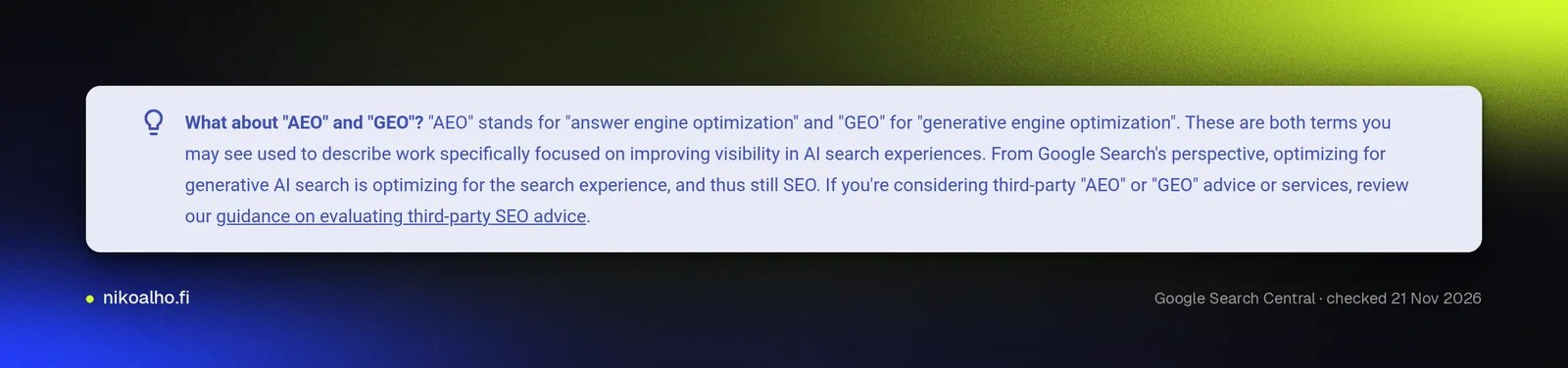 Optimizing your website for generative AI features on Google Search, captured 21 November 2026.
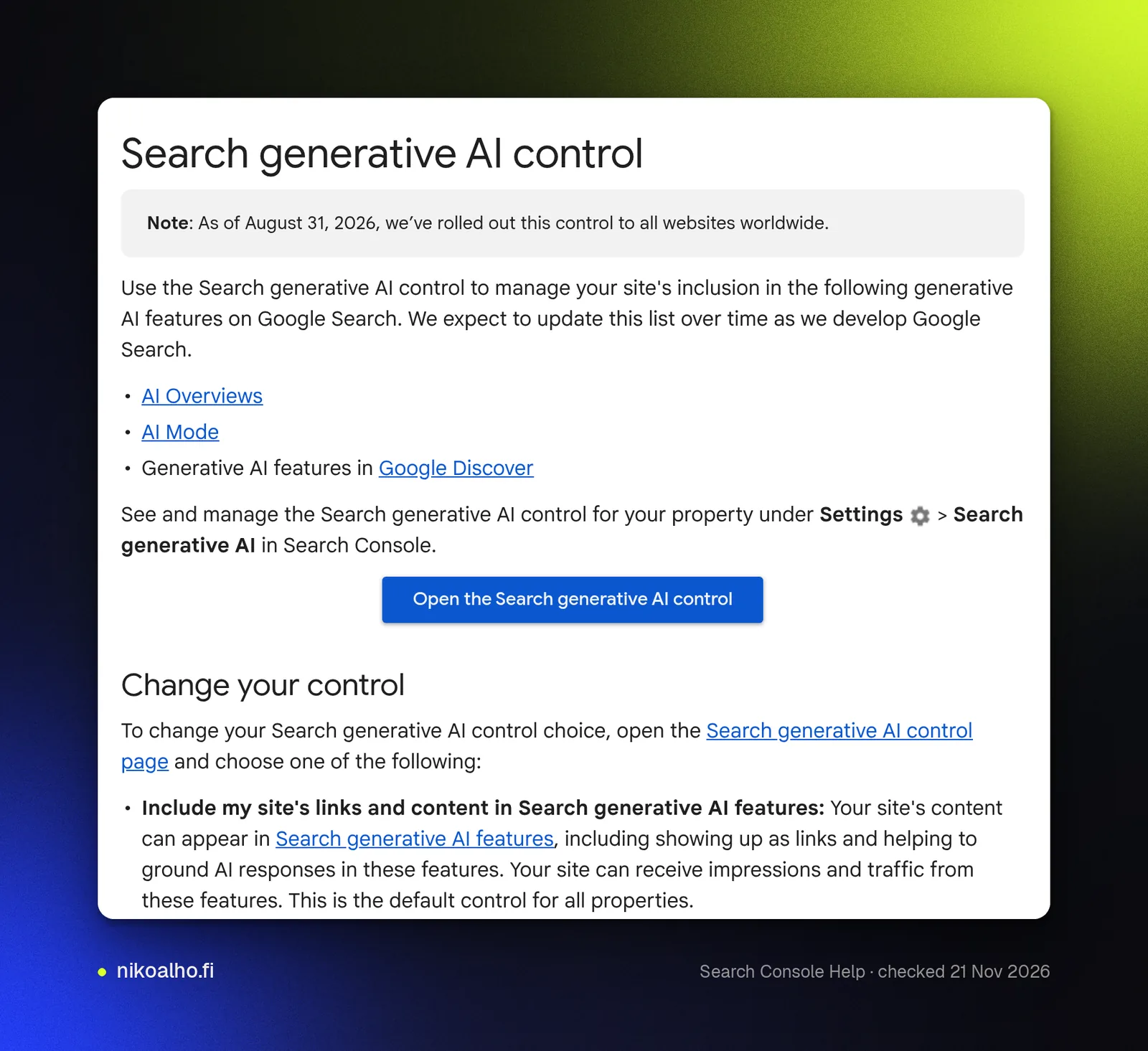 Search generative AI control, Search Console Help, captured 21 November 2026.
On nikoalho.fi I allow all of these on purpose. My robots.txt explicitly allows GPTBot, OAI-SearchBot, ChatGPT-User, PerplexityBot, ClaudeBot, Google-Extended, and CCBot, and the pages carry a Content-Signal: search=yes, ai-input=yes, ai-train=yes header. That is a business decision for a consultant whose product is being findable. A publisher selling content might decide the opposite. Either way, it is a decision to make deliberately, not a default to inherit from a CDN setting.
Everything SEO already requires — clean HTML, sensible internal links, canonical URLs, topical depth — is also GEO work. If you skip it, nothing in the next section helps. The technical SEO guide covers that layer.
Change 1: passages compete, not pages
In SEO a page competes with other pages for a position. In GEO a passage competes with other passages for a place in the answer.
An AI answer is assembled from a few extracted sentences, not from whole documents. Your 3,000-word guide does not win; the two sentences in it that answer the question cleanly do. That shifts the writing:
- Answer first in every section. The first one to three sentences under each heading should contain the complete answer. A reader who sees only that paragraph should not need the rest.
- Name the thing. “This approach” means nothing once a sentence is lifted out of context. Write “internal link automation with embeddings” instead.
- Use structures that extract cleanly. Tables for comparisons, numbered lists for sequences, a defined term in bold at the start.
None of this hurts SEO. Featured snippets reward the same structure, and readers skim the same way an extractor does.
Change 2: queries got longer, and clicks did not follow
In SEO the typical query is a few words. In AI search it is a full question, often with follow-ups. It frequently ends without a click.
I can see this in my own Search Console. Between 21 August and 18 November 2026, nikoalho.fi had 1,119 distinct queries of eight or more words. They produced 23,946 impressions — 26% of all impressions for the period — and 18 clicks.
A few of them, with average position:
| Query | Impressions | Avg. position | Clicks |
|---|---|---|---|
| how can i automate internal link discovery using embeddings and ai? | 828 | 1.8 | 0 |
| how can content engineers automate internal linking workflows? | 738 | 1.9 | 0 |
| can i use ai to auto-classify search intent across a content library? | 699 | 1.9 | 0 |
| can i automate internal linking using ai workflows? | 691 | 3.1 | 0 |
Nobody types “how can content engineers automate internal linking workflows” into a search box 738 times in three months. Each of these four appeared on 88 to 90 of the 90 days, which points to an AI visibility tool running the same prompt panel every day rather than to people. In my long-query study, 73% of long-query impressions on this site carry signs of automated prompt tracking. My page sits near the top of the results those tools see, and no visit follows.
That is the GEO trade in one table. You can rank first and get no traffic. The value, if there is any, is that your page shaped the answer — and that only pays off if the answer names you.
Change 3: the scoreboard is mentions, not clicks
SEO keeps score with rankings and clicks. GEO keeps score with whether you are mentioned, where in the answer, and whether the answer recommends you.
My AI Recommendation Index shows why one number is not enough. In June 2026 I ran six accounting-software buying prompts across six AI models: 36 answers. QuickBooks, Xero, and Wave each appeared in 31 of 36 answers — an identical 86% mention rate. QuickBooks was the first brand named in 24 answers, Wave in 5, and Xero in none.
A dashboard showing “86% share of voice” for all three is correct and nearly useless. The difference between them sits in position and recommendation, which is why I keep mention rate apart from first mention and explicit recommendation in AI share of voice vs. recommendations.
For SEO teams this is the biggest adjustment. A ranking is one number per query. An AI answer has to be read: are you there, are you first, are you recommended for the buyer who asked, and is the description of you accurate?
Change 4: what others say about you counts more
In SEO, other sites mostly help you through links. In GEO, their words about you can become the answer.
On 21 November 2026 I checked Google’s AI Overview for “geo vs seo” twice the same evening, through the DataForSEO SERP API. Both times it cited the same 9 sources: Semrush, Neil Patel, Contentful, Evertune, Informa TechTarget, Andreessen Horowitz, a Reddit thread on r/SEO, and two YouTube videos. Three of the nine were not articles on a company website.
The organic results returned for the same query changed noticeably between the two pulls; the cited sources did not. One query on one evening proves nothing general. It does show that forums and videos sit in the retrieval pool next to company articles, so the GEO job extends beyond your own domain.
Practically, that means:
- Be described consistently. The same name and one-line description everywhere you appear: your site, LinkedIn, review platforms, directories. Person or Organization schema with
sameAslinks ties them together. - Be present where the answer engines read. A useful answer in a relevant Reddit thread, a short video, or an inclusion in a third-party comparison can outweigh another blog post on your own site.
- Publish numbers others can cite. Original data gives other writers — and the models — a reason to name you. The Index above is my attempt at that.
The entity authority guide goes deeper on the consistency part.
Where AEO fits: AEO vs SEO vs GEO
AEO, GEO, LLM SEO, and AIO all describe the same shift: optimizing for answers instead of only for ranked links. The labels differ by origin, not by method.
| Term | Where it came from | What people mean by it in 2026 |
|---|---|---|
| SEO (search engine optimization) | Ranking in classic search results | Rankings and clicks, plus the technical and content foundation everything else needs |
| AEO (answer engine optimization) | Featured snippets and voice assistants, late 2010s | Getting your content chosen as the direct answer, now including AI answers |
| GEO (generative engine optimization) | 2023 research on LLM-generated answers | Getting mentioned and cited in AI-written answers |
| LLM SEO / LLMO | Practitioner shorthand | Same as GEO, usually focused on chat assistants |
| AIO | Agency shorthand, also used for “AI Overviews” | Ambiguous — check which meaning is intended |
My advice: do not split budgets or teams by acronym. Split by surface and metric instead: classic results measured in clicks, Google’s AI features measured in Search Console, and chat assistants measured with a prompt panel. The LLM SEO guide and the GEO pillar cover the assistant side in detail.
How to measure GEO and SEO together
Measure GEO with three layers next to your existing SEO reporting: Search Console, a fixed prompt panel, and analytics referrals.
- Search Console. Google points to the Generative AI performance report in Search Console for visibility in its AI features. For the pattern above, filter the standard performance report: add a query filter with the custom regex
^(\S+\s+){7,}\S+$to isolate queries of eight or more words, and track their impressions and clicks as a separate line. That is how I got the 26% figure above. Then separate out the prompt trackers, as described in what the long queries in my Search Console turned out to be. - A fixed prompt panel. Write 10–30 questions your buyers actually ask, run them on a schedule across the models they use, and record whether each answer mentions you, names you first, or recommends you. Keep the prompts fixed so changes mean something. The method is in how to measure AI share of voice.
- Analytics referrals. In GA4, track sessions from sources such as chatgpt.com, perplexity.ai, gemini.google.com, and copilot.microsoft.com, and which landing pages they hit. The volume is small for most B2B sites, but the landing pages tell you which passages the assistants trust.
Report them next to classic SEO metrics, not instead of them. If your SEO report already leads with pipeline, as I recommend in the SEO reporting template, GEO becomes one more input to the same question: is search, in any form, producing buyers?
What to do differently, in order
If you already do SEO well, GEO is a short list of additions, roughly in this order:
- Decide your AI crawler policy. Check robots.txt and CDN bot settings for each AI crawler: OAI-SearchBot, GPTBot, PerplexityBot, ClaudeBot, Google-Extended. Allow or block on purpose.
- Rewrite your top 10 pages answer-first. Start with the pages that already rank for questions. Put the complete answer in the first sentences of each section.
- Add one original number per key page. Your own data, a dated test, a cost breakdown. Generic pages get summarized; specific ones get cited.
- Fix your entity footprint. Consistent name and description everywhere,
sameAsin schema, and a complete profile on the review and directory sites your buyers use. - Show up off-site. Pick two places where your buyers ask questions — a subreddit, a community, YouTube — and answer there with substance.
- Start the prompt panel. Ten questions, monthly, recorded in a spreadsheet. A baseline you can trust beats an expensive dashboard.
- Report both scoreboards together. Clicks and pipeline from classic search; long-query impressions plus mentions and AI referrals from the rest.
If you want someone to run this list with your team, it is the scope of my AI search optimization work.
When GEO matters more than SEO, and when it doesn’t
GEO matters most when buyers research before they buy and ask an assistant for a shortlist. It matters least when the search ends in an immediate transaction or a local visit.
For a B2B software company, a consultancy, or any considered purchase, being named in “what’s the best X for Y” answers is closer to a referral than to a ranking. Losing that position costs pipeline you will never see in Search Console.
For an ecommerce product page, a local plumber, or a navigational query, the click still decides the outcome, and classic SEO plus Google Business Profile work deliver most of the value. Even there, the shared foundation means you are doing GEO’s prerequisites anyway.
My own numbers sit in the middle: a quarter of my impressions come from AI-style queries, and they produce almost no clicks. I treat that as brand exposure with an unknown conversion rate — worth structuring content for, not worth replacing SEO with. That is the honest answer to “GEO vs SEO” for most teams: keep the foundation, add the four changes, and measure both until your own data tells you where the buyers are.
Q01 Is GEO replacing SEO? +
Q02 Is GEO the same as AEO? +
Q03 Do I need different content for GEO than for SEO? +
Q04 How do I measure GEO? +
Q05 Can a small site win at GEO? +
- [01] STUDY
- [02] DOC
- [03] DOC
- [04] DOC
- [05] DOC
- [06] DATA
- [07] DOC