ON THIS PAGE 8 sections
What are vector embeddings in search?
Vector embeddings are numerical representations of text that map semantic meaning into a high-dimensional space. Search engines calculate relevance by measuring the geometric proximity between query and document vectors — relevance becomes mathematical, not string-based. Modern search uses hybrid retrieval (lexical + semantic) where embeddings drive the semantic half.
Vector embeddings in search are numerical representations of text that map semantic meaning into a high-dimensional mathematical space. Unlike traditional keyword matching, which relies on exact string matches, embeddings allow search engines to understand the relationships and intent behind words, calculating relevance based on the proximity of concepts rather than the frequency of terms.
If you are still optimizing density, you are fighting a math war with a dictionary. You will lose.
The digital landscape has shifted. The days of treating Google like a game of “Go Fish”—hoping your exact keywords match the user’s query—are over. Today, search engines operate on Hybrid Search models that prioritize semantic proximity alongside lexical matching. If you want to dominate the SERPs in 2026, you need to stop thinking in strings of text and start thinking in vectors.
What Are Vector Embeddings? (The Architecture)
To understand why legacy SEO strategies fail, you first need to understand how machines actually read.
Computers do not understand language. They do not know what a “SaaS platform” or “revenue pipeline” is. They only understand numbers. For decades, search engines used crude translation methods: if the user typed “cheap CRM,” the engine looked for documents containing the string “cheap CRM.”
Vector embeddings changed the physics of search.
An embedding takes a piece of text—a word, a sentence, or an entire document—and translates it into a list of floating-point numbers (a vector). These vectors are placed into a high-dimensional coordinate system.
The 3D Space Visualization
Imagine a 3D scatter plot suspended in a dark room. Each point of light represents a concept.
- Cluster A: The words “Revenue,” “Profit,” “EBITDA,” and “ROI” float tightly together. They are mathematically close because they share semantic DNA.
- Cluster B: The word “Banana” floats lightyears away in a different quadrant.
- Cluster C: The word “Apple” (the fruit) is near “Banana.” But “Apple” (the tech giant) is pulled toward “iPhone,” “MacBook,” and “Silicon Valley.”
In this high-dimensional space, the search engine doesn’t need to see the word “profit” to know your article about “increasing net income” is relevant. It calculates the distance between the two concepts — the same logic I unpack in semantic distance modeling. If the distance is short, you have high relevance — a prerequisite for ranking, though not the only factor.
Dimensions: The Nuance of Language
When we talk about “dimensions,” we aren’t talking about length, width, and height. We are talking about thousands of variables that define meaning.
OpenAI’s text-embedding-3-small model, for example, defaults to 1,536 dimensions. That means each text becomes a list of 1,536 numbers (text-embedding-3-large returns 3,072). Individual dimensions are not labelled features like tone or intent; subject matter, intent, technicality, and context are spread across all of them.
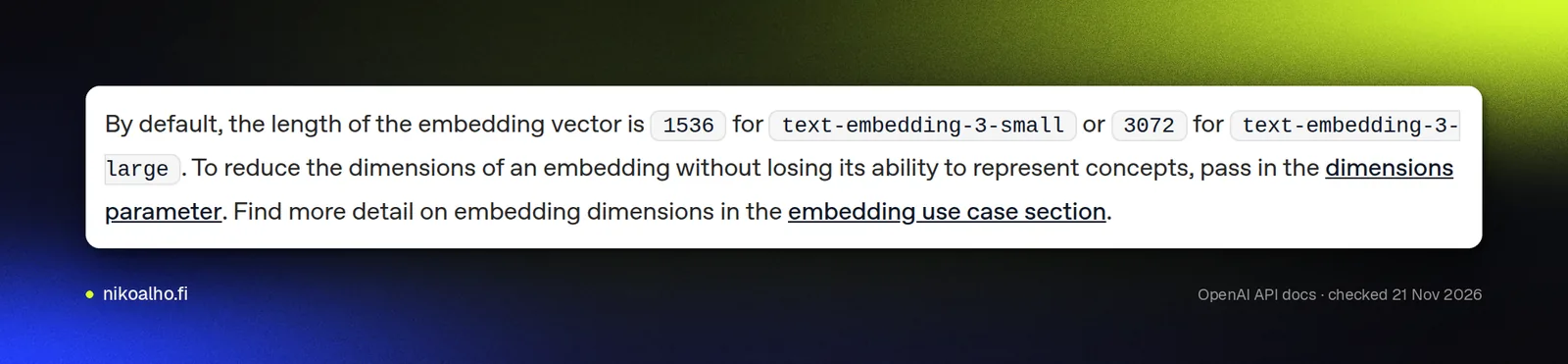 Vector embeddings, OpenAI API documentation, captured 21 November 2026.
Other providers pick other defaults. Cohere’s embed-v5.0-pro and embed-v5.0-fast default to 2,048 dimensions and embed-v4.0 to 1,536, and all three accept smaller sizes. Check the provider’s model table before you size a vector index.
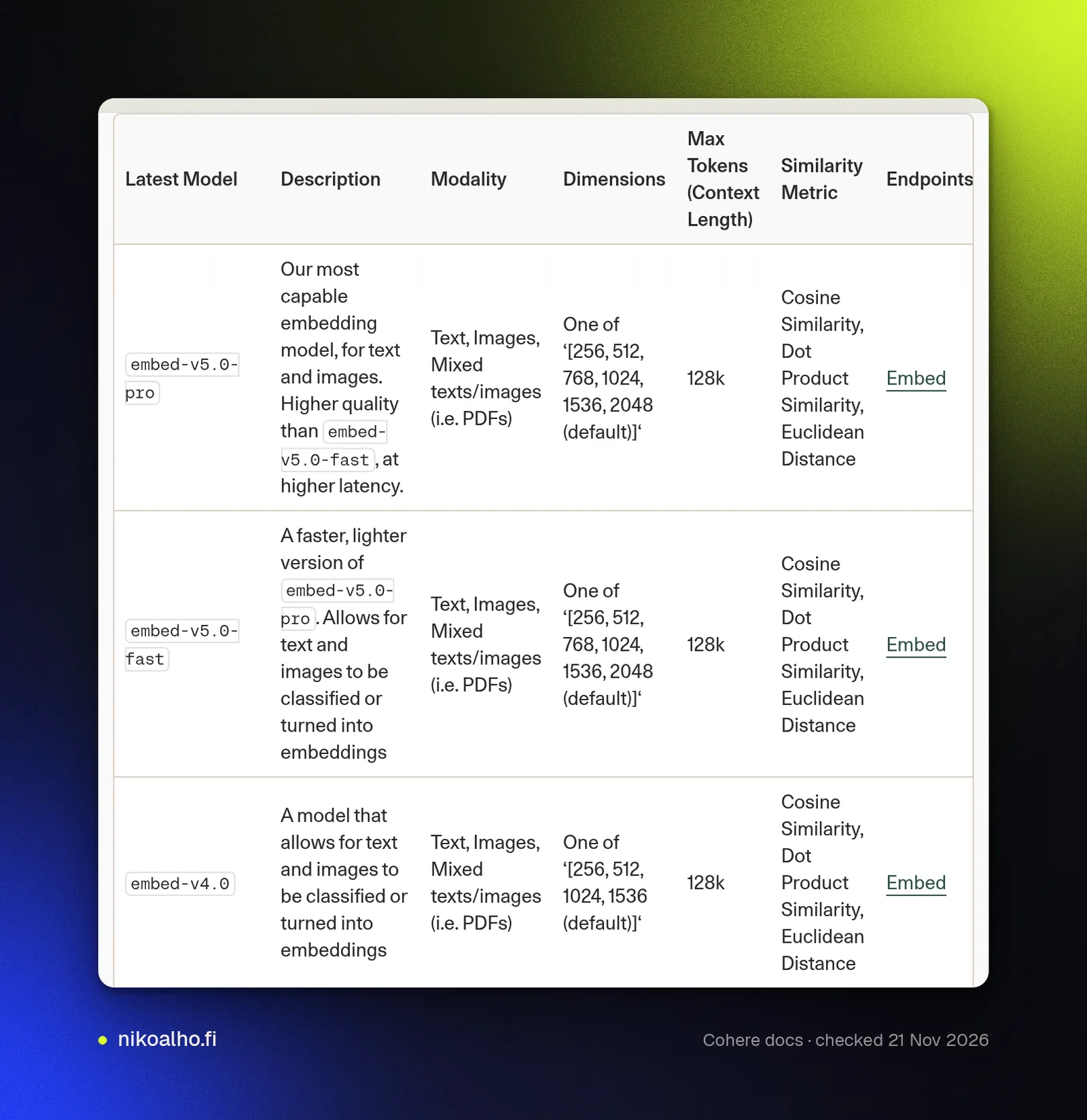 Cohere’s Embed Models, captured 21 November 2026.
This is the “fingerprint” of your content. If your fingerprint doesn’t match the vector profile of a high-value answer, no amount of backlinking will save you.
The “King” Analogy: Vector Arithmetic
To prove that vectors capture logic, not just definitions, we look to the canonical example of vector arithmetic. In a properly trained vector space, you can perform math on words:
vector(King) − vector(Man) + vector(Woman) ≈ vector(Queen)
This classic word-embedding result shows that some relationships, such as gender and royalty, can appear as consistent directions in the vector space: “Queen” is to “Woman” what “King” is to “Man.”
If a search engine can do this kind of math, do you really think it cares how many times you bolded the keyword “Best SEO Agency”?
See concepts cluster in vector space
Where a query lands in embedding space
Terms close together have similar meaning. The query lands inside the technical SEO cluster, so pages about those terms are retrieved first.
Nearest to the query · distance
- internal links0.10
- crawl budget0.25
- site audit0.27
- canonical tags0.37
- content brief1.08
How Search Engines Use Vectors to Understand Intent
The transition from purely lexical search to vector search is the difference between a librarian looking at book titles and a librarian who has read every book in the library.
Lexical vs. Dense Retrieval
- Lexical Search (The Old Way): This relies on algorithms like BM25 or TF-IDF. It looks for exact token matches. If the user searches for specific part numbers or unique error codes, this remains critical.
- Dense Retrieval (The New Way): This uses vector embeddings. The engine maps the query “automobile repair” to a vector. It then retrieves documents with vectors closest to that query in the multi-dimensional space. “Car fixing,” “vehicle maintenance,” and “mechanic services” all cluster in the same vector neighborhood.
Many hybrid search systems use methods such as Reciprocal Rank Fusion (RRF) to merge the two result lists, so both specific keywords and broad intent are captured. Google does not publish how it blends them.
The Algorithm Stack
This isn’t theoretical future-tech. This is the current operating system of Google.
- Knowledge Graph & RankBrain: Google describes RankBrain (2015) as its first deep learning system in Search, used to understand how words relate to concepts.
- BERT (Bidirectional Encoder Representations from Transformers): BERT reshaped search by reading context in both directions (left-to-right and right-to-left). It understands that the word “bank” means something different in “bank account” versus “river bank” based on the vector influence of the surrounding words.
- Neural Matching (2018): Google describes it as a retrieval system that matches concepts in queries and pages, even if the keywords don’t overlap.
The Calculation: Cosine Similarity
How does the engine decide relevance? It often starts with a calculation of Cosine Similarity.
Mathematically, this measures the cosine of the angle between two vectors.
- 1.0: The vectors are identical (Perfect Match).
- 0.0: The vectors are orthogonal (No relationship).
- -1.0: The vectors are opposites.
Your goal as a content architect is to minimize the angle between your content’s vector and the user’s intent vector. This is the core of modern semantic search technology—measuring distance, not counting words. However, remember that high semantic similarity must be backed by E-E-A-T signals to secure the top spot.
Lexical versus dense retrieval at a glance
Lexical, dense and hybrid retrieval
Lexical search matches the words. Dense retrieval matches the meaning. Hybrid systems run both and merge the result lists.
| Retrieval | Matches on | Exact terms | Paraphrases | Typical methods | Where it wins |
|---|---|---|---|---|---|
| Lexical | The same tokens in query and page | High | Low | BM25, TF-IDF | Part numbers and unique error codes |
| Dense | Distance between query and page vectors | Low | High | Embeddings, cosine similarity | "Automobile repair" finds "car fixing" |
| Hybrid | Both result lists merged into one ranking | High | High | Reciprocal Rank Fusion (RRF) | Specific keywords and broad intent in one query set |
High Medium Low
Optimizing Content for Vector-Based Retrieval
You cannot “hack” a vector. You cannot trick a neural network into thinking your low-quality listicle is a high-authority technical guide. The math is too honest.
However, you can engineer your content to align with the vector clusters Google rewards.
From “Targeting Keywords” to “Targeting Context”
Traditional SEOs start with a keyword volume tool. I start with a concept map.
When you optimize for vector search, you are optimizing for Entity Density. Google is looking for the related entities that define the vector cloud of a topic.
If you are writing about “Enterprise ERP Implementation,” the algorithm expects to see vectors related to:
- Data migration
- Change management
- Stakeholder alignment
- API integration
- Total Cost of Ownership (TCO)
If your content misses these concepts, your vector remains incomplete. You look like a shallow resource. By using machine learning in search rankings, engines punish content that meanders or stays on the surface. You need structural rigidity and comprehensive semantic coverage.
Structure Matters: The Vector Flow
Vectors rely on context windows. If your content creates a logical disconnect—jumping from “ERP pricing” to “History of Computers”—you break the semantic flow.
- Logical Hierarchy: Your H2s must conceptually support your H1. Your H3s must provide granular detail to the H2s.
- Contextual Continuity: Depending on how a system chunks the page, a paragraph’s embedding can include the text around it. A disorganized article creates a “noisy” vector signal, making it harder for the engine to confidently retrieve it for a specific query.
Gap Analysis: Finding the Missing Vectors
Most “content gap analysis” is useless because it only looks for missing keywords. A true gap analysis looks for missing meaning.
You need to identify what concepts your competitors cover that you don’t. Are they discussing “security compliance” in their ERP guides while you ignore it? That is a vector gap.
This is the foundation of gap analysis using vectors, allowing you to mathematically prove where your content is thin. If your competitor’s vector covers 90% of the topic’s semantic space and yours covers 60%, you are at a disadvantage.
The Technical Edge: Python for SEO
Most SEO agencies are afraid of code. They rely on “proprietary tools” that are just wrappers for basic APIs.
To truly audit your semantic footprint, you need python for seo. You need to stop guessing how relevant your content is and start measuring it.
Below is a Python script concept that uses OpenAI’s embeddings (via langchain or direct API) to calculate the cosine similarity between a user query and your headline versus a competitor’s headline.
The Architect’s Script: Measuring Relevance
import numpy as np
from sklearn.metrics.pairwise import cosine_similarity
from openai import OpenAI

# Initialize client (Ensure you use secure environment variables for keys)
client = OpenAI(api_key="YOUR_API_KEY")

def get_embedding(text):
    response = client.embeddings.create(
        input=text,
        model="text-embedding-3-small"
    )
    return response.data[0].embedding

# 1. Define the User Intent (The Query)
query_text = "Best enterprise CRM for financial services"

# 2. Define the Contenders
my_headline = "Top 10 CRMs for Business Growth in 2026"
competitor_headline = "Secure, Compliant CRM Solutions for Banking and Finance"

# 3. Generate Vectors
query_vec = np.array(get_embedding(query_text)).reshape(1, -1)
my_vec = np.array(get_embedding(my_headline)).reshape(1, -1)
comp_vec = np.array(get_embedding(competitor_headline)).reshape(1, -1)

# 4. Calculate the 'Angle' (Similarity)
my_score = cosine_similarity(query_vec, my_vec)[0][0]
comp_score = cosine_similarity(query_vec, comp_vec)[0][0]

print(f"My Relevance Score: {my_score:.4f}")
print(f"Competitor Relevance Score: {comp_score:.4f}")

# ANALYSIS:
# The competitor wins because their vector contains concepts
# specific to the query (Security, Compliance, Banking),
# whereas 'Business Growth' is too generic.
Why This Matters
This isn’t just a coding exercise. This is agent-driven entity extraction and analysis in real-time.
By running this logic across your headers, meta descriptions, and core body paragraphs, you can measure semantic fit before you publish. It is one input among many, not a ranking prediction. You stop hoping Google likes your content and start engineering it to match the target vector.
Cost is rarely the blocker. Hosted embeddings are priced per token: Voyage AI lists voyage-4 at $0.06 per million tokens, and the first 200 million tokens on each voyage-4 model are free for every account.
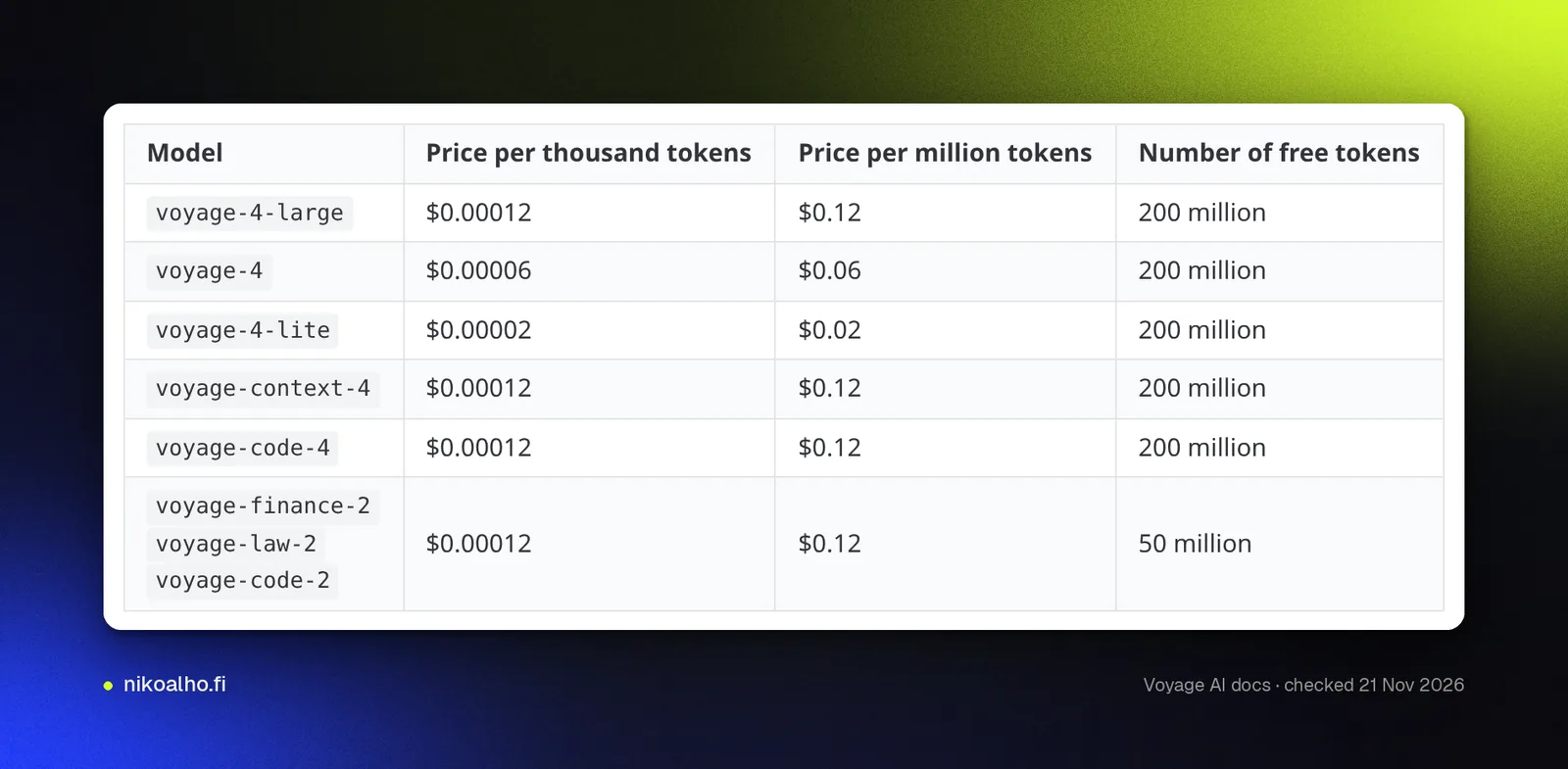 Pricing, Voyage AI documentation, captured 21 November 2026.
Once you master this on a single page, you can scale it into advanced semantic analysis across your entire domain — the same logic behind semantic SEO for AI — monitoring your semantic health as rigorously as your server uptime.
Estimate the cost of embedding your pages
What it costs to score your pages with embeddings
The script embeds each page and each target query, then compares them. Enter what you would embed and the provider's price.
Conclusion: Build Systems, Don’t Chase Algorithms
Vector embeddings are not a trend. They are not a “2026 update.” They are the fundamental infrastructure of how machines process information.
The era of “tricking” the search engine is dead. The algorithm processes data with a level of dimensionality that human intuition cannot match — which is why entity-based SEO is a better use of effort than keyword-density tactics.
If you want to drive revenue through organic search, you must stop treating content as “creative writing” and start treating it as data injection. You must align your digital assets with the high-dimensional reality of the search environment.
- Stop counting keyword density.
- Start mapping semantic clusters.
- Stop writing fluff.
- Start engineering answers that minimize the distance between user intent and your solution.
Does your content strategy map to the mathematical reality of search? If not, you are optimizing for a version of the internet that no longer exists.
Let’s audit your architecture.
Q01 What embedding model should I use? +
Q02 How does Google use embeddings in ranking? +
Q03 What's hybrid retrieval? +
Q04 Can I optimize content for embeddings? +
- [01] DOC
- [02] BLOG
- [03] BLOG
- [04] GUIDE
- [05] DOC
- [06] DOC
The same pipelines I run for paying clients — written up first for subscribers.