ON THIS PAGE 10 sections
What is automated competitive intelligence?
Automated competitive intelligence is the deployment of software agents and data pipelines that continuously monitor competitor pricing, content, sitemap changes, and code shifts — then route the signal directly to the team that owns the response. Unlike quarterly audits, it functions as always-on surveillance with action triggers.
Automated competitive intelligence is the deployment of software agents and data pipelines to continuously monitor, analyze, and report on competitor activities without human intervention. Unlike manual audits, which are static snapshots, this system functions as always-on surveillance, using Agentic AI to detect pricing shifts, content gaps, and structural changes in real-time.
Stop guessing. Start engineering.
What is Automated Competitive Intelligence?
The traditional approach to competitive intelligence is a failure of logic.
In most B2B organizations, “competitive analysis” is a quarterly ritual. A junior strategist spends 40 hours manually trawling through competitor websites, taking screenshots, pasting them into a slide deck, and presenting a SWOT analysis to the board. By the time that PDF is exported, the market has moved. The pricing page you analyzed three weeks ago has already been A/B tested and changed twice.
This is not intelligence. It is archaeology.
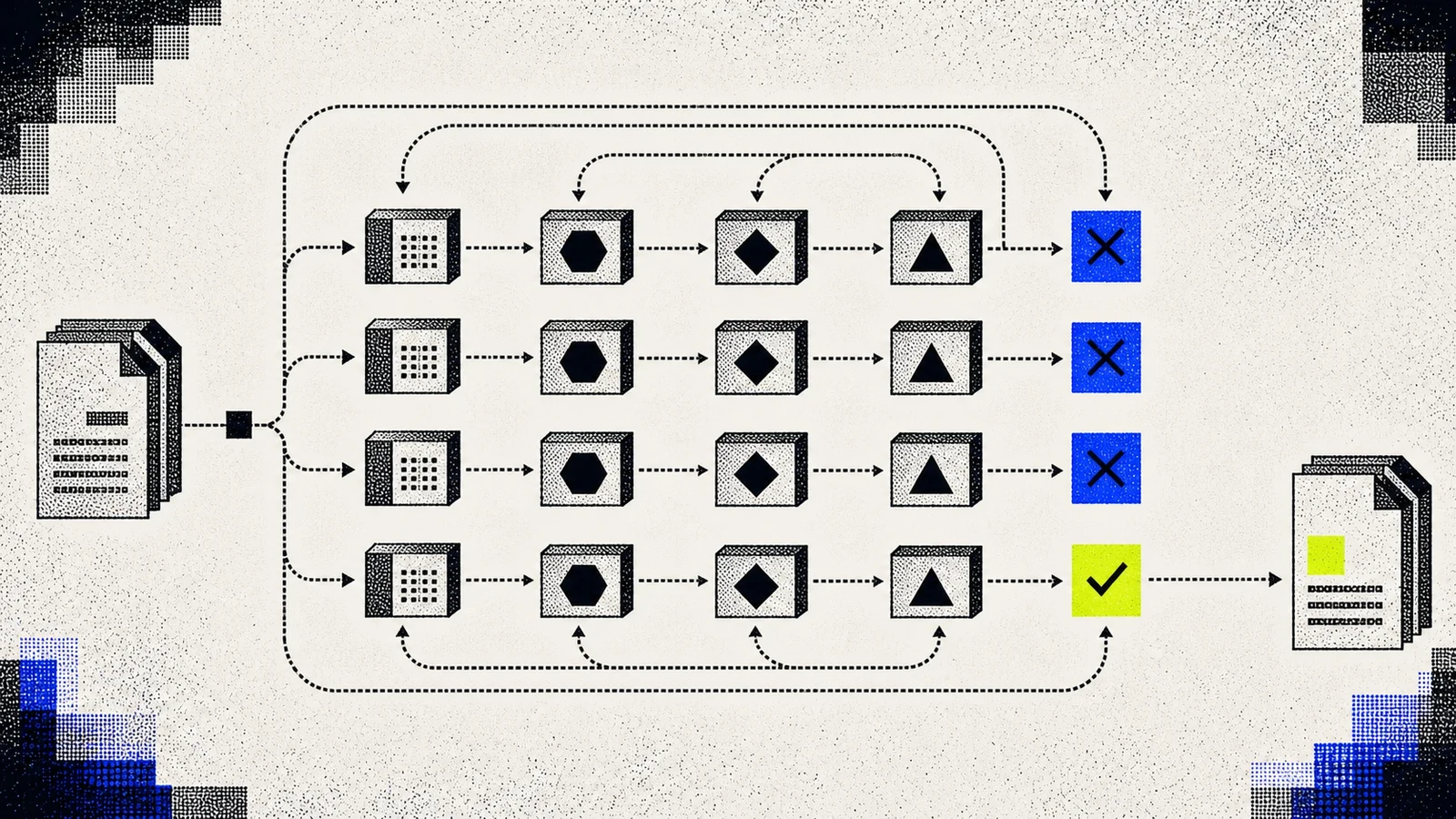
Automated competitive intelligence replaces manual latency with code. It treats market research as a software engineering problem. Instead of humans visiting websites, we deploy headless browsers, Python scripts, and Agentic AI workflows to monitor the digital footprint of your rivals 24/7/365.
The Shift: From Snapshots to Streams
We operate in a data velocity environment that exceeds human processing speed. A SaaS competitor can deploy code to production many times a day. They can alter their value proposition dynamically based on user IP or launch hidden landing pages for specific enterprise accounts.
A human cannot see this. A script can.
The shift is fundamental:
- Periodic Check-ins $\rightarrow$ Continuous Monitoring
- Subjective Interpretation $\rightarrow$ Data-Backed Reality
- Marketing Fluff $\rightarrow$ Operational Intelligence
This system does not just “scrape” data. Scraping is easy. The value lies in the synthesis layer—using Large Language Models (LLMs) to ingest raw HTML, interpret the semantic meaning of a change, and decide if it matters to your bottom line.
Why Manual Competitor Audits Fail in B2B SaaS
If you rely on manual audits, you are flying blind. In the high-stakes arena of B2B SaaS, where Customer Acquisition Cost (CAC) is high and Lifetime Value (LTV) is the holy grail, the cost of information latency is calculated in lost revenue.
The Latency Problem
Your audit is obsolete the moment you save the file.
Consider a scenario: Competitor X drops their entry-level pricing tier by 20% to undercut your market share.
- Manual Approach: You find out 6 weeks later during a “strategy review.” By then, every quote your sales team sent in those six weeks was compared against a price you did not know about.
- Automated Approach: Your market surveillance system detects the DOM change on their pricing page at 09:00. By 09:05, an alert is pushed to your Slack channel. By 10:00, your sales team has a counter-script ready.
Speed is not a luxury. It is a competitive moat.
The Cost of Inaction: A Financial Model
Most organizations fail to model the cost of manual intelligence versus automation.
Let’s look at the math, with illustrative assumptions:
| Metric | Manual Analyst | Automated Python Pipeline |
|---|---|---|
| Execution Frequency | Quarterly (4x/year) | Hourly (8,760x/year) |
| Coverage | Top 3 Competitors | Entire Market (Unlimited) |
| Depth | Surface level (Pricing/Home) | Full Site (Sitemaps, Changelogs, Code) |
| Cost Basis | €150/hr (Consultant Rate) | €0.02/run (Cloud Compute) |
| Result | Static PDF | Real-time Database |
At those assumptions, paying a strategist for 40 hours a quarter costs roughly €24,000 annually for four snapshots. An automated system runs for a fraction of that compute cost, executes thousands of times more often, and eliminates human error.
Note: While compute is cheap, achieving Technological Sovereignty requires an initial engineering investment. However, unlike a salary, you pay for the architecture once and own the asset forever.
Cognitive Bias vs. Algorithmic Truth
Humans are terrible observers. When a marketer looks at a competitor’s site, they often validate their own biases.
Agentic AI has no ego. It simply observes the data. If a competitor starts publishing heavily on a topic you thought was irrelevant, the AI notes the anomaly. If they remove a feature from their pricing page, the AI flags the subtraction. It provides a brutal, unfiltered view of market reality.
The Architecture of a Market Surveillance System
I do not sell “tips.” I build Growth Engines. To achieve dominance, you must own the architecture. Relying on third-party SaaS tools (“black boxes”) leaves you dependent on their feature roadmap.
This is the blueprint for a Python-based competitive intelligence architecture.
Layer 1: The Ingestion Pipeline (Scraping & APIs)
The foundation is the Ingestion Pipeline. We use Python for SEO automation to retrieve raw data. The stack typically involves headless browsers like Playwright, orchestrated by a task runner.
What to Monitor
- Sitemaps (XML) & Internal Links: Monitoring
sitemap.xmlis standard, but many B2B enterprises now obfuscate or chunk their sitemaps. A solid system supplements this with “Discovery Agents” that crawl internal link structures to detect new pages even if they are hidden from the main sitemap. - Pricing Pages (DOM Elements): We target specific
<div>and<span>classes containing price points. Any change in the Document Object Model (DOM) triggers a diff check. - Changelogs & Documentation: Marketing pages lie; documentation tells the truth. Monitoring developer docs reveals what features are actually shipping.
- Hiring Boards: If a competitor posts 10 jobs for “React Native Developers,” they are building a mobile app. If they hire “Enterprise AE - DACH Region,” they are expanding into Germany.
The Technical Implementation
We do not just “visit” pages. We render them. Modern web architecture (React, Vue) requires JavaScript execution to see the content.
# Pseudo-code logic for a basic Change Monitor
import hashlib
from playwright.sync_api import sync_playwright

def check_for_changes(url, previous_hash):
    with sync_playwright() as p:
        browser = p.chromium.launch()
        page = browser.new_page()
        page.goto(url)

        # Extract specific content (e.g., pricing table)
        content = page.locator('.pricing-table').inner_html()

        # Create a hash of the current content
        current_hash = hashlib.md5(content.encode('utf-8')).hexdigest()

        if current_hash != previous_hash:
            return True, content, current_hash
        return False, None, previous_hash
This script is simple, but lethal. Run it every hour. The moment the hash changes, you know something happened.
Layer 2: The Analysis Engine (Vector Embeddings & RAG)
Raw HTML is data, not intelligence. To make it useful, we need an analysis layer using Agentic AI and Vector Embeddings.
Semantic Understanding with Vectors
When we scrape a competitor’s new landing page, we pass the text through an embedding model (any current hosted or open-source one) to convert it into a vector—a string of numbers representing the meaning of the content.
We store these vectors in a Vector Database (like Pinecone or Weaviate). This allows us to perform competitor gap automation by querying concepts rather than keywords. The LLM competitor-gap workflow turns those semantic differences into a scored, reviewable content queue.
- Query: “Has Competitor Y changed their messaging regarding data security?”
- System Action: The system retrieves historical vectors of their security pages and compares them to the current vector.
- Result: “Yes. In Q1 they emphasized ‘Encryption at Rest.’ Today, they shifted to ‘GDPR Compliance.’ This suggests a pivot toward EU enterprise clients.”
This uses RAG (Retrieval-Augmented Generation) to transform raw diffs into strategic summaries.
Layer 3: Operational Activation (Dashboards & Alerts)
Data without distribution is waste. The final layer is Operational Activation.
I operate on a strict principle: No Noise. Executives only want to know when a threshold is breached.
- Pricing Changes $\rightarrow$ Trigger a webhook to Slack #sales-alerts.
- New Content Clusters $\rightarrow$ Trigger a task in Asana/Jira for the Content Team.
- Technical Errors $\rightarrow$ Logged for the SEO team (if they break their canonical tags, we can capitalize).
See the surveillance pipeline architecture
From a page change to an alert the right team sees
Scraping is the easy part. The value sits in the step that decides what a change means and whether anyone needs to hear about it.
- 01
Ingest
A scheduler runs Playwright against sitemaps, pricing pages, changelogs and job boards, rendering the JavaScript.
Passes onRendered page content - 02
Detect
Hash the watched element and compare it with the previous run.
Passes onA diff, only when the hash changed - 03
Interpret
Embed the new text, compare it with stored vectors and let an LLM summarize what shifted.
Passes onA short summary of the change - 04
Route
Only changes past a threshold go out: pricing to sales, content clusters to editorial, technical errors to SEO.
Passes onSlack alert, Asana or Jira task, or log entry
Building vs. Buying: The Intelligence Stack Calculation
A common question: “Why don’t we just buy Crayon or Klue?”
You can. For generic data, they are fine. But in B2B tech, “fine” is where revenue goes to die.
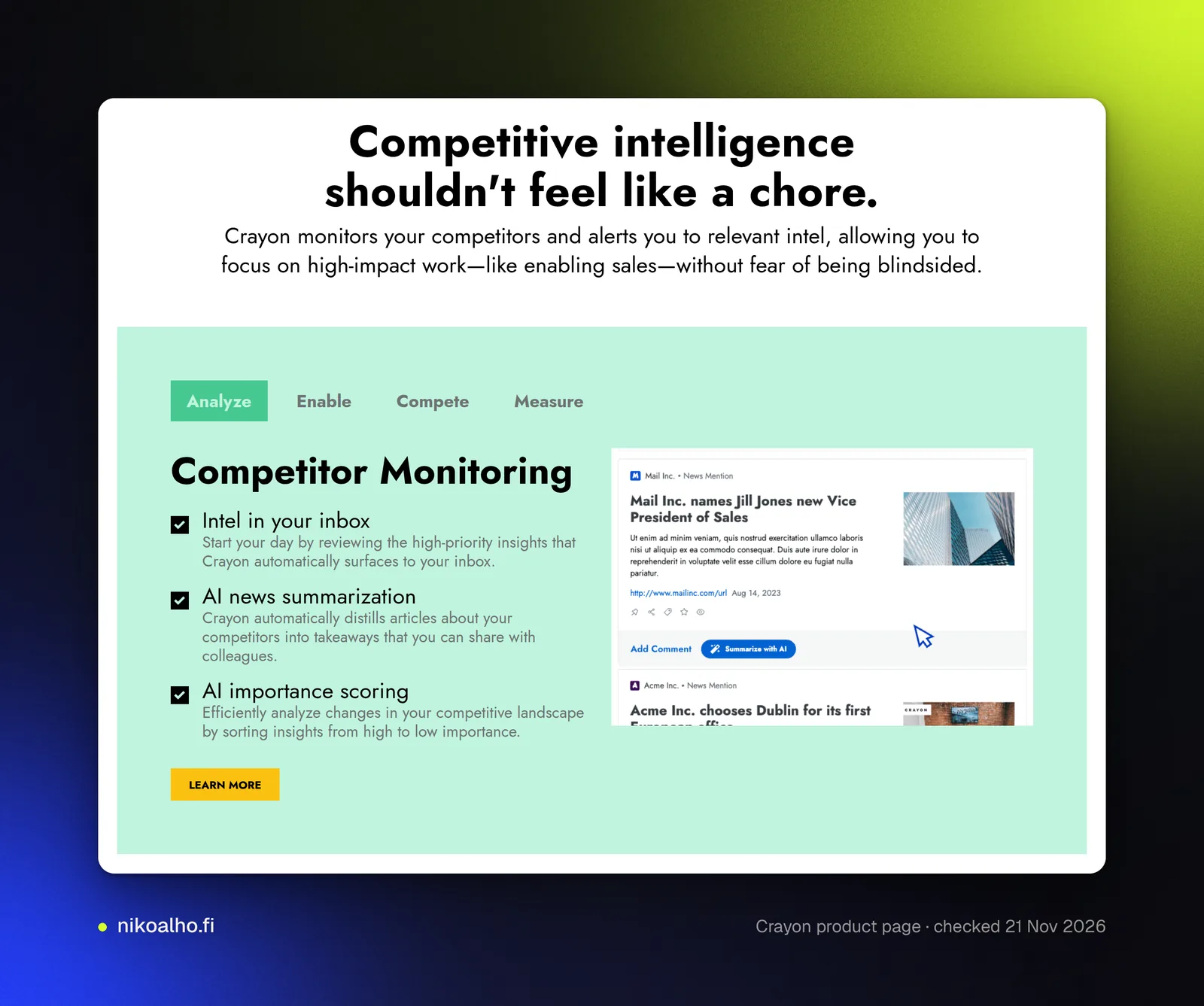 Crayon product page, captured 21 November 2026. Crayon quotes pricing on request.
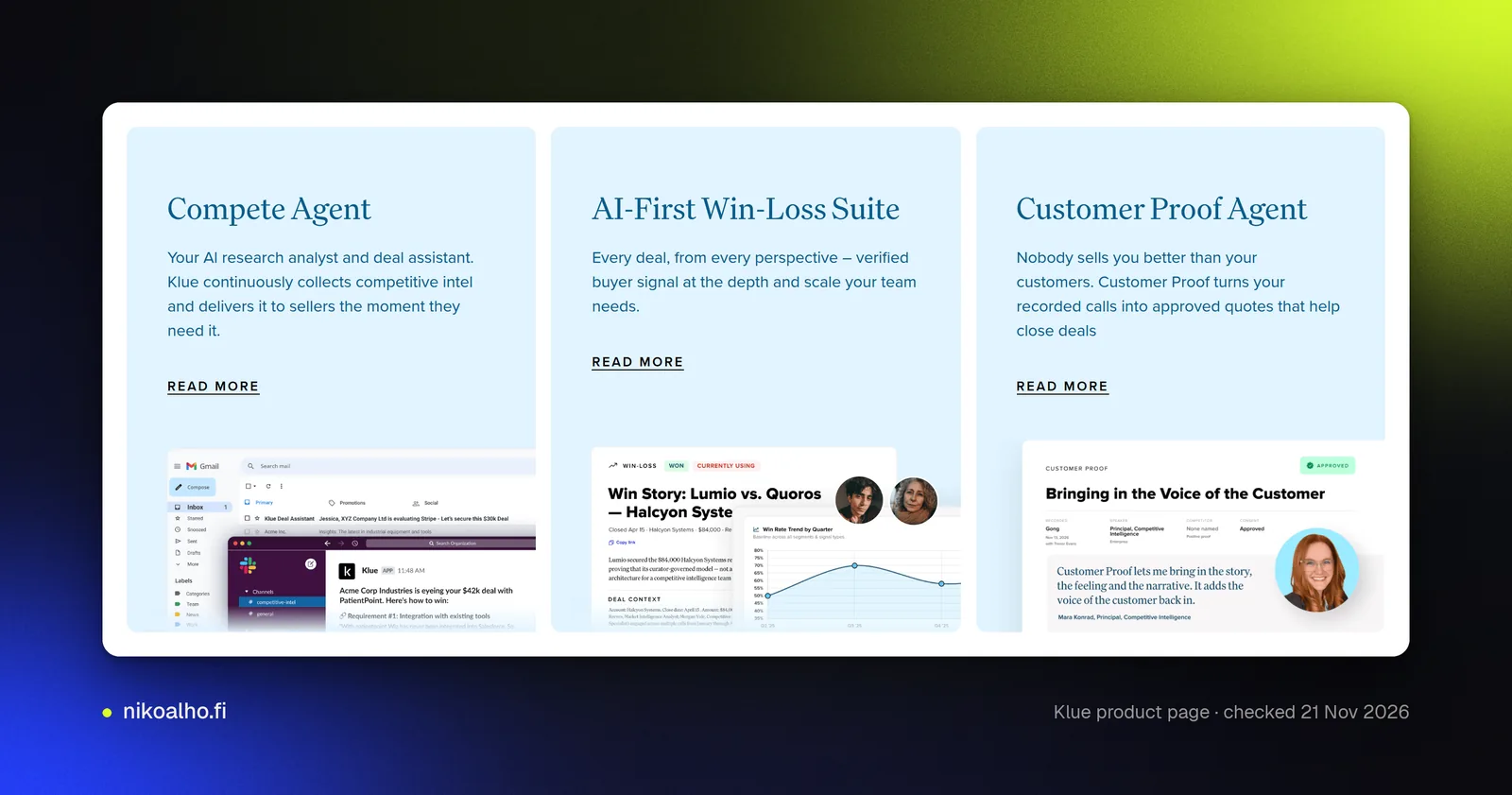 Klue product page, captured 21 November 2026. Klue does not publish pricing.
The SaaS Trap
When you buy an off-the-shelf CI tool, you buy a black box.
- Limited Scope: You only monitor what they allow.
- Shared Intelligence: Your competitors likely use the same tool. There is no information asymmetry.
- Lack of Integration: Exporting data into your proprietary Growth Engine is often restricted.
The ROI of Custom Architecture
The question every board asks is whether the investment pays off. Proving intelligence ROI requires connecting system outputs to revenue metrics. Building a custom Python stack gives you Technological Sovereignty.
ROI = ((revenue protected + new revenue gained) − (build cost + compute cost)) ÷ build cost
- Revenue Protected: If you spot a competitor undercutting you and save one Enterprise deal worth €50k, the system pays for itself.
- New Revenue Gained: If you identify a content gap and rank for a high-intent keyword that brings in €100k pipeline, the ROI is exponential.
Estimate the return on a custom stack
First-year return on a custom monitoring stack
The article's formula: revenue protected plus new revenue gained, minus build and compute cost, divided by the build cost.
The Components of a Lethal Surveillance Strategy
To execute this, monitor these four specific pillars. Do not waste compute resources on vanity metrics. Focus on revenue drivers.
1. Structural SEO Shifts
Monitor robots.txt and directory structures.
- Why: If they block a directory, they are hiding something. If they add
/integration/salesforce, they are launching a partnership. - Action: Feed new URL structures into your technical SEO architecture map to visualize their site hierarchy evolution.
2. The Content Velocity Index
It is not enough to know what they publish. You must know the velocity.
- Metric: Words published per week per topic cluster.
- Insight: If velocity on “Cloud Security” jumps from 0 to 5,000 words/week, they are making a play for that vertical.
- Response: Deploy Agentic AI workflows to counter-flood that topic before they establish authority. This is where a deliberate topical authority strategy becomes your defensive moat.
3. Pricing & Packaging Telemetry
This is the most critical revenue signal.
- Monitor: Price points, currency options, feature gating, and discount offers.
- Insight: A competitor moving “SSO” (Single Sign-On) to a lower tier is an aggressive move to capture mid-market deals.
- Response: Alert the sales team immediately. Adjust your battle cards.
Public pricing pages are the easiest place to start. Semrush and Ahrefs, two of the tools in the comparison, publish their tiers openly, so a monitor can diff plan names, prices, and feature lists on every run.
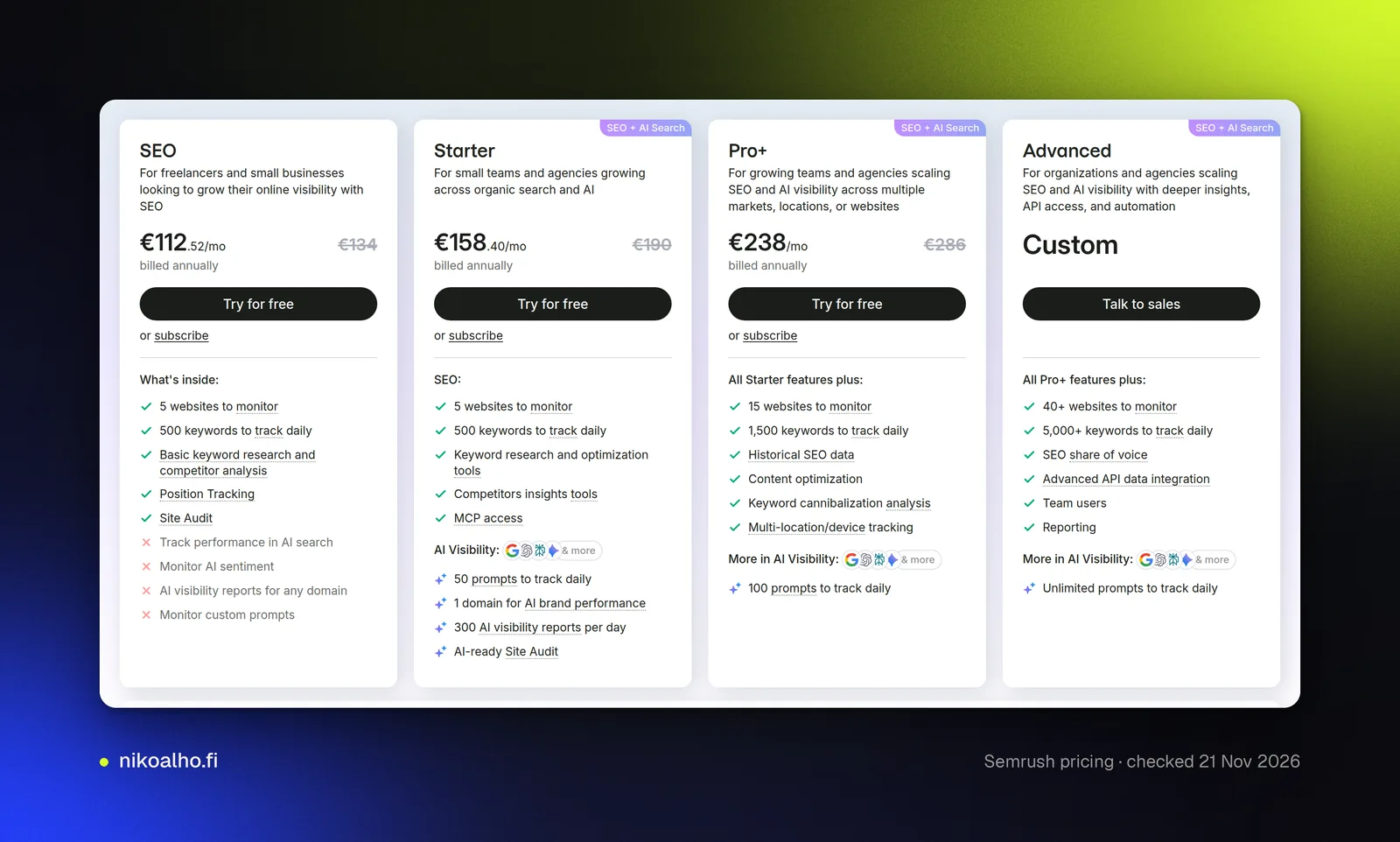 Semrush pricing page, captured 21 November 2026 (prices as shown to a visitor in Finland, excl. VAT).
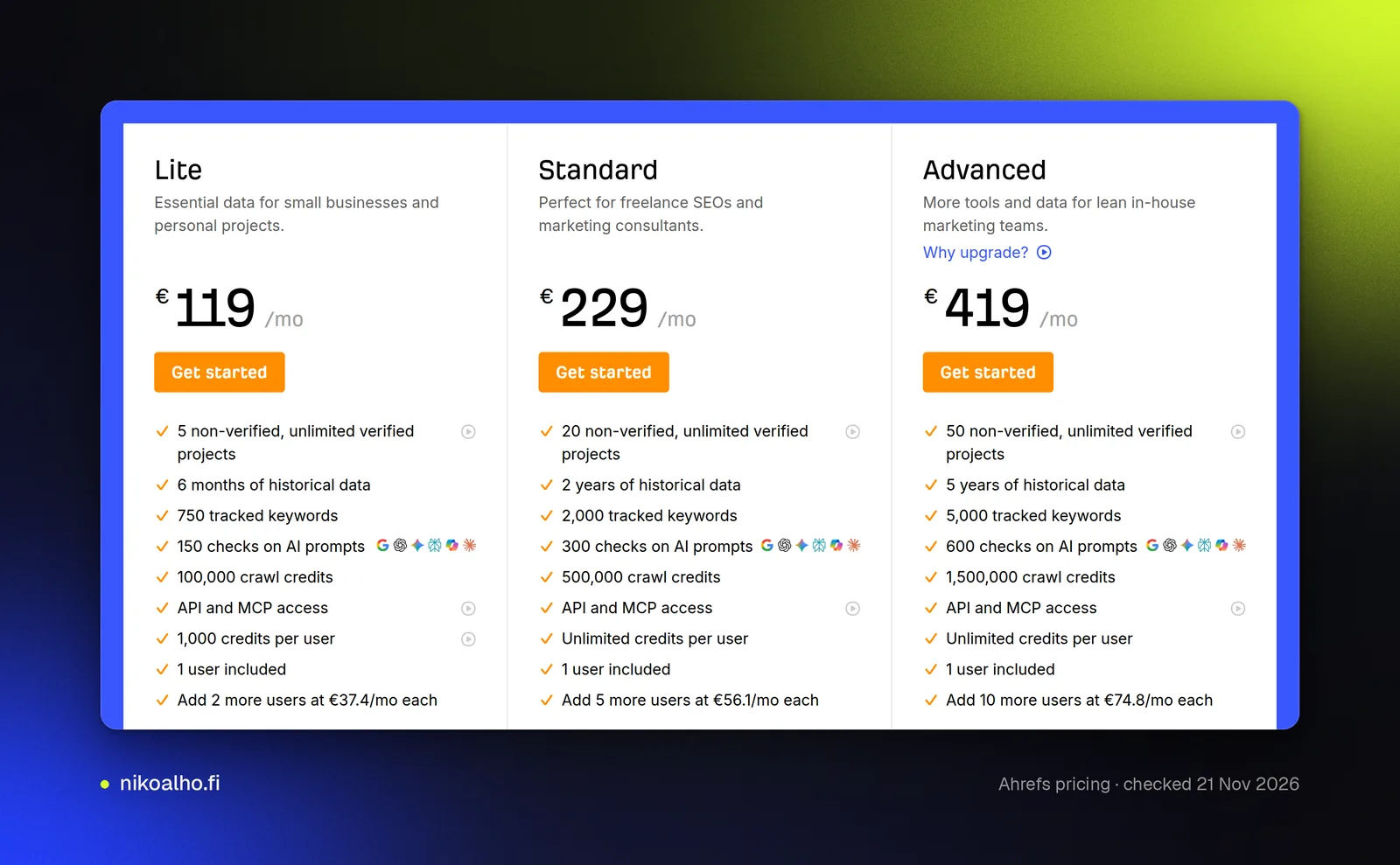 Ahrefs pricing page, captured 21 November 2026 (prices as shown to a visitor in Finland, excl. VAT).
4. Talent & Hiring Signals
A company’s job board is its roadmap.
- Monitor: Key roles in Engineering and Sales.
- Insight: Hiring for “React” = New UI. Hiring for “Japanese Speaker” = APAC expansion.
- Response: Strategic planning at the board level.
What to monitor and who acts on it
Four signals to monitor, and who acts on each
Watch revenue drivers, not vanity metrics. Each signal has an owner who responds.
| Signal | What to monitor | What a change can mean | Response |
|---|---|---|---|
| Pricing and packaging | Price points, currencies, feature gating, discounts | SSO moving to a lower tier to win mid-market deals | Alert sales at once and update the battle cards. |
| Structural SEO shifts | robots.txt and directory structure | A new /integration/salesforce path signals a partnership | Add the new URLs to your map of their site hierarchy. |
| Content velocity | Words published per week per topic cluster | Cloud security going from 0 to 5,000 words a week | Cover the topic before they establish authority. |
| Talent and hiring | Key engineering and sales roles | An enterprise AE for DACH signals a move into Germany | Feed it into strategic planning at board level. |
Advanced Tactics: Agentic AI Workflows
We are moving past simple scripts. We are entering the era of Agentic AI. An “Agent” is an AI model given a goal, tools, and autonomy.
The “Documentation Scout” Agent
Active interaction with chat bots can violate Terms of Service or be blocked by anti-bot protections. Instead, use a “Scout” agent.
- Goal: Determine technical limitations of a competitor’s product.
- Action: The agent reads public API documentation and support forums, looking for phrases like “currently not supported” or “limitations.”
- Result: A list of technical weaknesses your sales team can use in competitive deals.
The “Review Sentinel” Agent
An agent that monitors G2, Capterra, and TrustRadius.
- Action: It scrapes new reviews, categorizes sentiment, and extracts specific feature complaints.
- Output: “Competitor X’s users are complaining about ‘slow reporting’ in 40% of new reviews.”
- Strategy: Your marketing copy immediately pivots to emphasize “Lightning-Fast Reporting.”
Conclusion: The Death of the Quarterly Audit
The era of the static competitor report is over. It is a relic of a slower time.
If you are paying agencies to manually click through websites, you are burning capital. Worse, you are operating with a time lag that your market will not forgive.
Automated competitive intelligence is not a luxury. It is the baseline for survival in a high-velocity economy. It transforms the internet into a structured dataset that feeds your decision-making process in real-time.
You have two choices:
- Continue with the manual, reactive approach and wonder why you are losing market share.
- Architect a system that provides omniscience.
Stop looking at the market. Build a machine that sees it for you.
[Audit your system. Let’s engineer your intelligence stack.]
Competitive intelligence agents are one of the highest-ROI starting points inside an agentic SEO architecture. They turn weekly competitor monitoring from a manual analyst task into a short review of flagged changes.
Q01 What can I monitor automatically? +
Q02 What's the minimum stack to start? +
Q03 How does this differ from rank tracking? +
Q04 Is this ethical or legal? +
- [01] DOC